


Employee retention is the company’s ability to keep its employees retained in the organization by keeping them motivated, and engaged in productive tasks. It is a way to reduce employee turnover by involving strategies that will help enhance the job satisfaction of employees.
It involves techniques such as pay parity, enhancement in employee engagement, attractive compensation and benefits, recognition and rewards for proficient work, providing a healthy work culture, work-life balance, and career advancement opportunities. To improve employee retention strategy, the mentioned techniques are crucial to be implemented because employees are more likely to stay in a positive work culture where their work is recognized and paid well and given growth and development for the future without compromising their mental health.
In this blog, we will give you an insight into the employee retention meaning, employee retention strategies, the importance of retaining employees, the mere objective of retention, factors affecting employee retention, and more.
The primary objective of an employee retention strategy is to keep the employees rooted in the organization. The major objectives of employee retention also include:
Employee retention is dependent on several factors, which are central to ensuring their well-being in the company. If your employees feel valued and are actively engaged with your organization, they will stay longer with your company.
Hence, if you wish to retain them as longer-term employees, it is essential to consider the four basic pillars of employee retention, which include:
The effective onboarding process for new hires starts by attracting candidates from the job market with the right set of skills as well as those who are an ideal cultural fit for the company.
Hence, it is essential to have a well-defined job description that will help them understand the work as well as the work culture with the help of dedicated career pages. Such measures will ensure that you attract many workers who would want to work for your organization.
Monotonous repetitive work and lack of career growth opportunities are major factors for why employees leave their organizations.
Hence, it is essential to provide continuous training to the staff to help them get new skills, upskill themselves as well as ensure continued productivity.
Providing such training opportunities will help the staff to stay engaged with your company, effectively retaining them.
Having an engaging work culture is essential for helping your staff stay longer with your organization. An engaging work culture promotes ownership of the work, which can be achieved by clearly defining the role of each team member.
Additionally, you can also recognize them in front of their peers for their work, which promotes a culture of mutual respect and motivation too. Rewards and recognition serve as a motivating factor for the employees to perform efficiently and stay rooted in the organization.
Another effective way of ensuring employee retention is to provide a secure environment for the staff to undertake their tasks well. It is especially relevant for companies that require their staff to work in hazardous environments.
Hence, the company should ensure that adequate health and safety protocols and measures are in place to avoid accidents, as it leads to improved employee experience.
Since employee retention is essential for the correct functioning of any organization, it is essential to have some handy tactics that provide the employees with multiple reasons to stay with their company.
Such tactics will ensure that your best employees decide to stay longer, helping you avoid repetitive hiring and training as well as leaving you with long-term staff who are engaged and satisfied with your organization.
Here are some robust employee retention tactics that will enhance the retention rate of the organization and will also increase productivity.
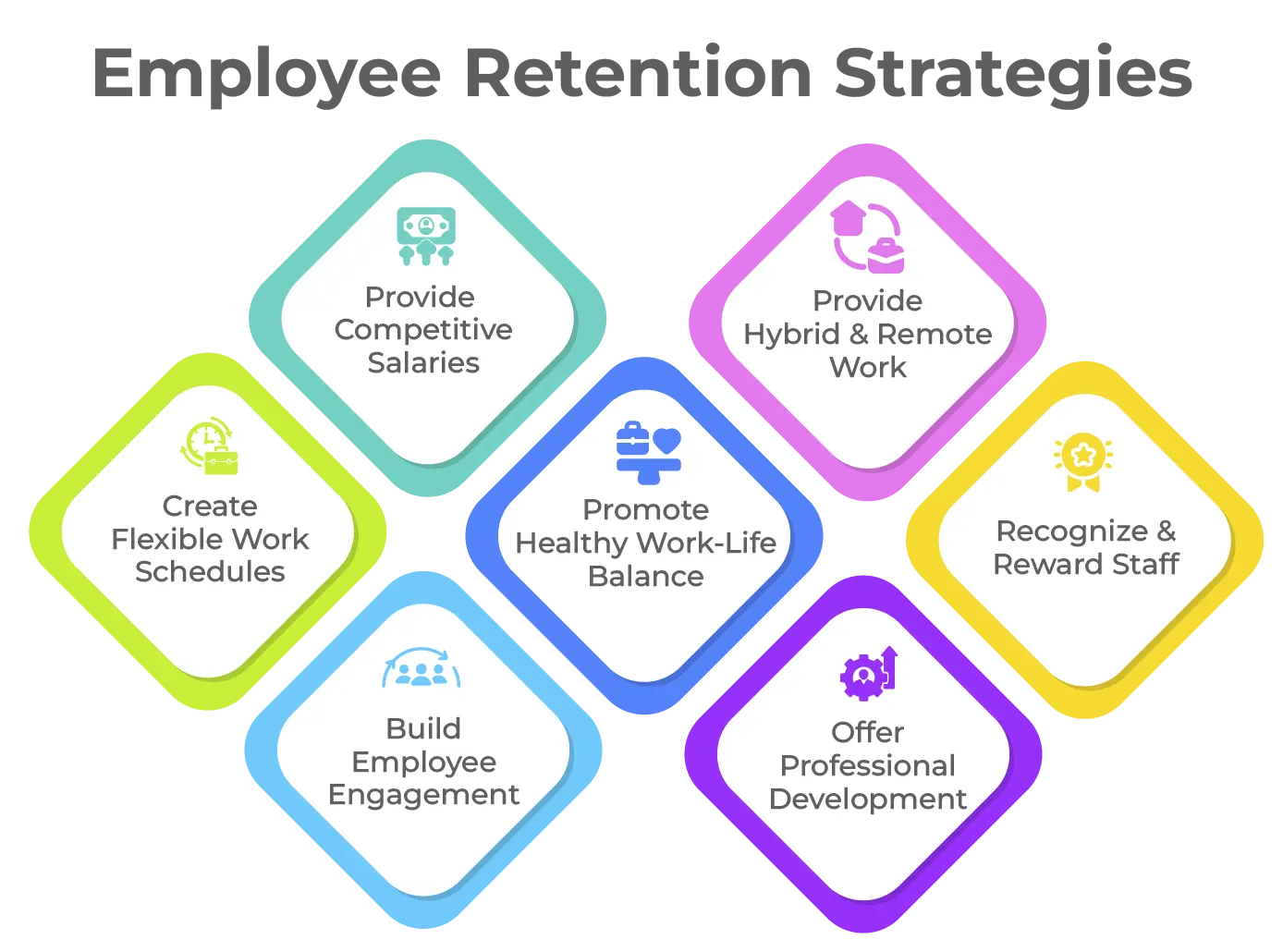
The most basic tactic to ensure employee retention is to provide them with competitive pay and salaries. It is extremely important to pay your employees adequate salaries on time to let them feel valued.
Additionally, employees expect their wages to be appraised according to the inflation rate to ensure that their efforts are valued and are noticed by the employees. Hence, you should start by understanding the standard of living in the location of your organization and the salaries being offered by your competitors in the market to ensure you pay equal to or more than that for retaining employees and eliminating their distractions.
Another opportunity for improvement is to provide your staff with enhanced flexibility in terms of how they undertake their work. Use a robust attendance management system to track the attendance of employees working from a remote or hybrid setup.
For example, you can provide remote work opportunities to enable your new employee as well as existing ones to work from their homes, helping them maintain a better work-life balance. You can also provide hybrid working facilities where employees will have to work from the office for 2-3 days and work from home to provide convenience to both the employer and the employee.
You can also provide flexible working hours, which will further enhance their lifestyle, making it easier for them to complete their tasks on time, while also enabling you to retain them longer.
Such features also help them understand the trust and responsibility conferred on them, improving their engagement with your company.
By providing flexible work opportunities and remote work options, you can ensure a better work-life balance for your workforce. The HRMS software plays a vital role in ensuring easy management of the workforce and promoting work-life balance.
You can also go one step further by avoiding frequent meetings as well as any contact with your staff during their non-working hours unless it is an emergency.
Such initiatives would further strengthen the trust placed by your staff in your company, enhancing your retention rate.
By recognizing the top performers from the performance management system and rewarding them with adequate promotions and compensation, for their contributions, you let them understand their value to the company.
Such employees would also be more productive and remain engaged with their work since they understand that they matter. Hence, it is essential to recognize your staff for their efforts and reward the ones who work well.
If you implement all the tactics from this article, you can ensure that your staff will stay engaged with your company for longer.
While employee engagement and job satisfaction are dependent on multiple factors, they can be increased by letting your staff know how relevant they are to the team building your company’s culture. By having employees who are engaged, you will also be able to retain your top talent for longer.
Employees who are engaged and satisfied with their workplace have reduced burnout, while others may experience burnout despite the workload remaining the same. Hence, it is essential to avoid employee burnout with the help of these statistics.
You should offer your staff multiple opportunities to upskill themselves as it improves their skills and makes them more productive. On the other hand, it also lets them understand that their company is genuinely investing in their staff.
Such realization will help them stay longer with their organization since they will want to remain associated with an organization that enables them to better their skills.
Most retention efforts are reactive. By the time an employee resigns, the decision is already made, and an exit interview only tells you what went wrong after it is too late to fix it for that person.
A stay interview flips the timing, as it is a structured conversation with a current employee, conducted before they are at risk of leaving, aimed at understanding what’s keeping them engaged and what might eventually push them out.
According to Gallup, 42% of employees who voluntarily leave a job say their manager or organization could have done something to prevent it. Gallup’s research also found that 45% of voluntary leavers had no conversation with a manager about their job satisfaction or future in the three months before they quit. The pattern is not that managers make bad decisions. It is that the conversation never happens at all.
Schedule a stay interview separately from a performance review. A stay interview is not an evaluation, and mixing the two makes employees guarded rather than candid.
Ask direct, open questions:
Once you have the answers from your employees, act on what you hear and follow up, since a stay interview that produces no visible change trains employees to stop being honest in the next one.
| Stay Interview | Exit Interview |
|---|---|
| Conducted with current employees | Conducted with departing employees |
| Proactive, aimed at prevention | Reactive, aimed at diagnosis |
| Can lead to immediate improvement for that employee | Insights only help future employees |
| Best run regularly at specific intervals | Run once, at the point of departure |
Employee retention rate is the measurement of the employees staying in the company versus the number of employees who left the company within a specific period, measured as a percentage.
Employee Retention Rate Formula:
Employee Retention Rate for a Period = (No. of Employees who stayed within the period / No. of Employees at the Start of the Period) * 100
The importance of employee retention for a company is crucial and holds greater significance in the long-term sustainability of the business. Let us understand in detail.
Employee retention helps in improving the productivity of the company as your company doesn’t have to waste time in the hiring process, which not only consumes a lot of time but also resources and finance in training the new hires.
Also, your employees are already acquainted with the work culture; they won’t waste time and will perform to their finest capabilities to achieve the business goals.
The importance of employee retention is the reduction of turnover rate, which majorly affects the company’s turnover rate and contributes to saving costs, time, and valuable resources that are valuable for the organization.
The enhancement in the retention rate of employees surges the company’s reputation and goodwill in the competitive market. Also, it showcases the company’s credibility to keep employees satisfied in their jobs and productive at the same time.
The employee retention strategy enhances the employee connection with the organization and keeps them rooted in the workplace. It also enhances their trust in the company as a result of which a sense of belongingness surges in them yielding productivity and efficiency in working.
Employee retention diminishes the employee turnover rate which results in reducing the cost incurred in hiring and training new candidates. Also, the cost of the recruitment process, also is effectively saved with the retention of efficient employees.
End Note
To conclude, your company needs to let your employees understand their importance to your organization. It will help them remain engaged with your company as they work to enhance the products and services.
As a result, it will increase employee engagement and enable them to stay longer and remain actively engaged. Implementing the ten effective employee retention strategies we provided in this article will help you boost your retention rate and increase employee engagement too.