


Gender equity is mandatory in the workplace. To uphold it, companies implement multiple gender-related policies, including the ePOSH Policy, Equal Remuneration Policy, Women’s Night Shift Policy, and Maternity Benefit Policy. Among these, the Maternity Benefit Policy is a mandatory workplace policy that protects the rights and wellbeing of women during pregnancy and childbirth.
Reinforcing its significance, on 23 May 2025, the Supreme Court of India observed that, ‘Maternity leave is integral to maternity benefits. Reproductive rights are now recognized as part of several intersecting domains of international human rights law, namely the right to health, the right to privacy, the right to equality and non-discrimination, and the right to dignity.’ With this perspective, let us understand the Maternity Benefit Act, its provisions, and the benefits it offers women employees as they embark on one of life’s most meaningful journeys: motherhood.
Maternity Leave is the leave granted to female employees of an organization to take care of their pregnancy and the newborn after birth. It is one of the most important types of leave as it is also applicable in cases where a child is adopted, as the maternity leave helps the mother bond with their child. It also helps the mother in recuperating from childbirth, as well as helping her recover from postpartum stress. Since it is a time of physical, emotional, and physiological changes in the mother, maternity leave acts as the ideal time for them to rest as well as take care of their newborn.
Maternity leave lets expecting mothers take long-term paid leave to rest during and after pregnancy. The Government mandates it, so organizations must provide it to their female employees.
Article 42 of the Constitution directs the State to provide maternity relief. The Maternity Benefit Act, 1961, puts this into effect. It provides mothers with paid leave, medical bonuses, and other benefits from pregnancy through a few weeks after birth. The Act was amended in 2017. The amendment increased the leave duration, added work-from-home, and included adoption and commissioning for mothers. It did not replace the 1961 Act. There is one Act, updated in 2017.
The right to pay ensures female employees are paid during maternity leave. Any employee eligible for leave is eligible for pay, whether the employer is private or Government. The rate is a percentage of her average daily wage before the leave. Employers who fail to pay face fines or imprisonment, depending on the breach.
The Act empowers the Government to make Rules under Section 28. The Rules cover the working detail, such as forms, notices, registers, and how a woman claims her benefit. The Central and State Governments each have their own Maternity Benefit Rules. The Rules sit under the Act and cannot go beyond it.
Female employees are eligible for maternity leave if they fulfil the following criteria:
There are various benefits of implementing a maternity leave policy by deploying a dedicated leave management system in your organization:
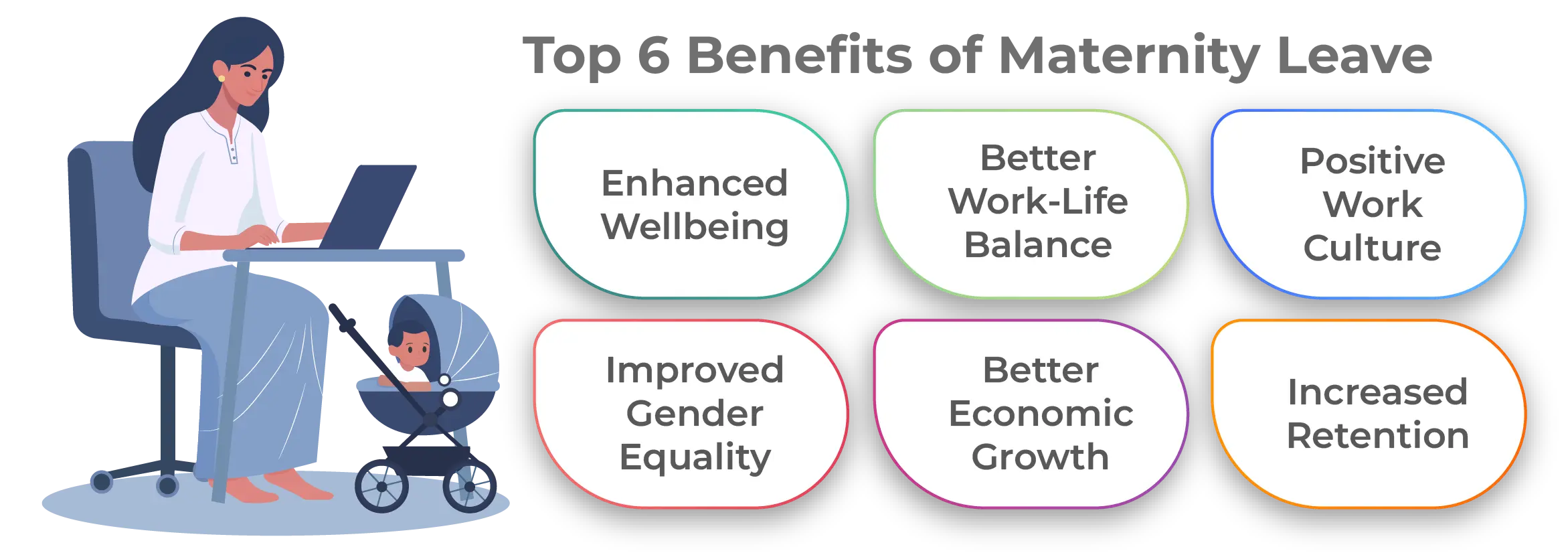
The most important benefit of the maternity leave policy is the improved well-being of the mother and the child as they get more time together. It is especially crucial during the initial weeks after childbirth, as it helps develop the bond between the child and the mother. Similarly, since maternity leave is taken during pregnancy, it reduces the physical and mental strain on the mother by allowing them to completely concentrate on their body and the child.
Since maternity leave policies also consider the mental stress on the mother and restrict companies from assigning stressful tasks to employees during their pregnancy, they help improve their work-life balance. Combined with the leaves provided, it gives the mother adequate time to adjust to the changes in her mind and body during the pregnancy phase, as well as to adapt her lifestyle to accommodate a child.
Maternity leave policies help employees realize their importance to the organization. It helps them understand that they are valued as assets and that, hence, their work-life balance is important to the company. As a result, employees remain engaged, creating a positive work environment. It helps them stay loyal to their organization, as their job security is ensured by the maternity policies, which can be accessed through their ESS portal.
Since women are naturally evolved to care for infants, maternity leave policies help them fulfil their role as mothers, at least during the initial years of their child’s life. It helps them fulfil their duties as mothers without risking their financial stability. Hence, maternity leave is one of the best ways to promote gender equality in the workplace.
Maternity leave provides financial stability to mothers during their stressful period of pregnancy and childbirth. It ensures the health of mothers and newborns by helping them avoid work stress. All these factors motivate females to remain a robust part of the workforce, promoting economic growth.
Additionally, employees can understand that their company values them and considers them an asset through the implementation of robust maternity leave policies. It improves staff members’ engagement rates and helps them stay with their company longer. Hence, maternity leaves also result in improved retention rates within organizations.
Conclusion
Maternity is a period of happiness and fulfilment for all females and their employment should not hamper this important part of their life. The maternity leave policies ensure that female staff members can provide the time and energy towards their motherhood without getting concerned about their work. Understanding and implementing the various policies of the Maternity Benefit Act not only ensures compliance with the law but also enhances the well-being efforts of the organization, resulting in increased engagement and retention.
According to the Maternity Benefit Act, the maternity leave policy in India is as follows:
These rules apply to companies employing 10 or more employees, including both private and Government organizations.
Under the Maternity Benefit Act, government employees are eligible to take 26 weeks of maternity leave for their first two children. However, for subsequent children, the leave duration is reduced to 12 weeks. Similarly, a 12-week maternity leave is provided to female employees who adopt a child under 3 months of age.
The maternity leave duration in India varies based on the number of children an employee has. For the first and second child, it is 26 weeks, while for subsequent children, it is 12 weeks. Similarly, adopting mothers or surrogate mothers are also entitled to 12 weeks of leave, according to the provisions of the Maternity Benefit Act.
Yes, maternity leave is a paid leave in India. Female employees are entitled to fixed pay during their leave period, calculated as a percentage of their average daily wage. Having this financial support for mothers during their time away from work enables them to take care of their newborns.
In India, maternity leave can be taken from 8 weeks before the expected delivery date. The remaining 18 weeks can be taken after the delivery. However, for employees with 2 or more children, the leave can be taken up to 6 weeks before the expected delivery date. According to the Law, the total paid maternity leave is 26 weeks for the 1st and 2nd child, and 12 weeks for subsequent children.
Yes, according to the Maternity Benefit Act, maternity leave in India can be extended beyond the standard 26 weeks. The Act allows extensions in cases of illness arising from pregnancy, delivery, premature birth, or miscarriage. Additionally, employers can grant additional leave upon mutual agreement with the employee.
To be eligible for maternity leave in India, a female employee must have worked with their employer for at least 80 days in the 12 months preceding her expected delivery date. This eligibility applies to all working women in India, covering all industries, including the public and private sectors.