


A leave policy is an essential part of HR management. Employers must be aware of leave policies when they organize leave for employees. A proper balance should be struck between paid, non-paid, and national holidays.
Besides, arranging leave types assists employers in transparency during onboarding, as many candidates ask about the leave policy. A clarified leave policy maintains the company’s commitment to employee well-being and cultivates a culture of trust, inclusivity, and mutual respect.
Different policies or national and state laws exist regarding the selection of leave count for a particular year. The Factories Act of 1948 enacts laws the Indian Factory Act. For other establishments like IT/ service companies, shops, etc., the policies are determined under the Shops & Commercial Establishments Act.
Apart from the mandatory leave types, companies provide several other essential ones.
This blog will highlight India’s different types of leave, followed by those of other states. Moreover, what kinds of leaves do the government and other employees receive?
Here is a list of different types of leave the company plans for a fiscal or calendar year. Employees can use the leave management system to apply for leave on or before the due date.
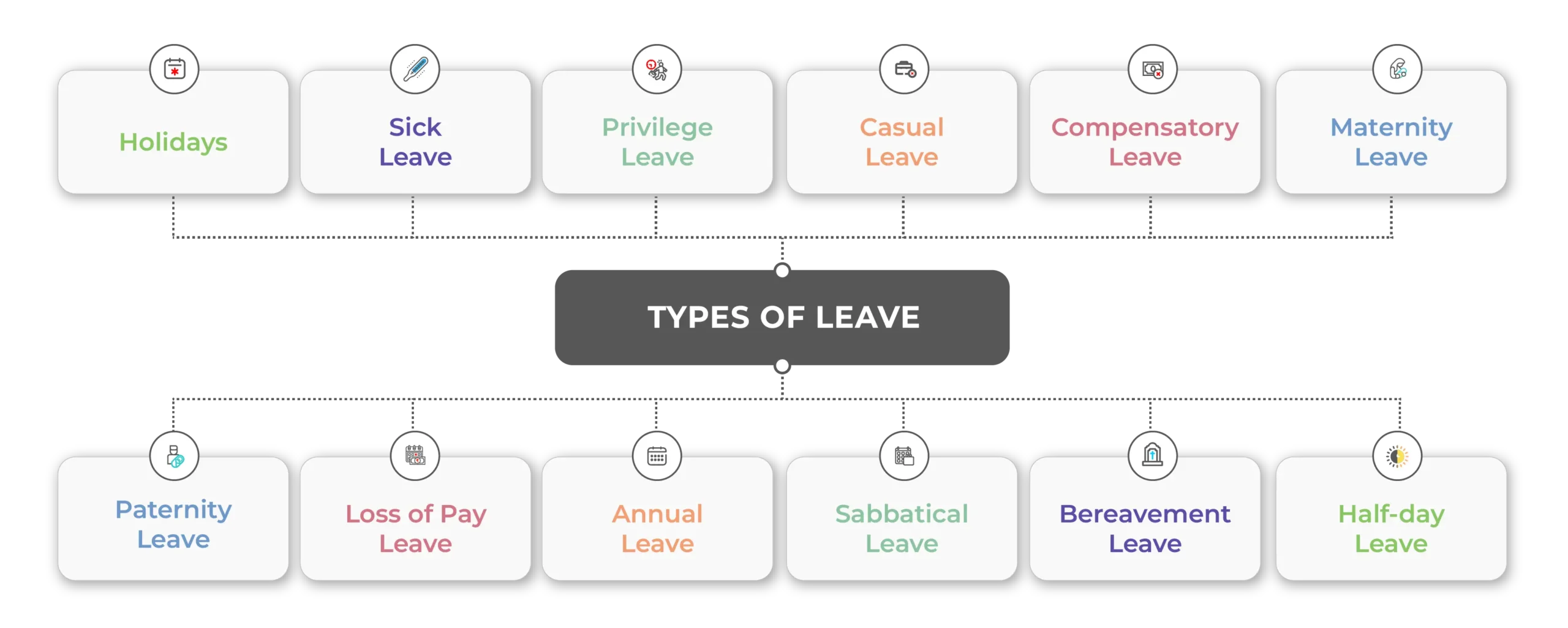
‘Holiday’ is one of the company’s mandatory leave counts, which companies must follow. It includes national or regional based big festivals and other government holidays, etc. It is also popularly known as a public holiday.
All government companies and most public and private entities arrange public holidays for employees. These mainly include Independence Day, Holi, Dussehra, Republic Day or any announced date in memory of the death or birth of renowned people in India. Mandated holidays are one type of Leave for employees in India.
Sick Leave is the next mandatory leave type that an employee expects from the company. It is used when employees feel ill and take time off. This leave provides sick employees time to recover completely before rejoining.
However, whether or not a particular organisation provides such Leave depends on that organisation. With the provision of SL, employees need not worry about their pay cut, as they are paid for the homestay. The company itself sets the number of Leave or Sick Leave. It can be anywhere around 10-15 per year.
Read More:
The definition of the leave type is the same as its name. In this leave type, the employees get privileged by receiving leaves as their claim. The company mainly rewards employees with this paid Leave (PL).
The leaves can be around 20-22 per year, depending on companies and their HR. These are the days when employees can take a day off and enjoy themselves without losing pay. Thus, the name paid Leave is earned Leave. Employees only need to get the Leave approved by the manager to take advantage of it. If you wish to know more about Privilege Leave, we have covered it in depth including its calculation, eligibility criteria, and more.
Casual Leave is another essential type in which employees take a day or days off for personal reasons or without a cause, unlike paid Leave.
The primary reason for such leaves is religious Leave, like Eid and other minority festivals. Employees here enjoy paid Leave for the day. The number of casual leaves per year is around 3 to 5, which can neither be encashed nor carried over to the following year. This is highly dependent on the manager’s approval.
Compensatory Leave is available for companies where HR performs overtime management. Companies often pay extra and provide a day off to employees who work overtime. It is a paid Leave received by sales or marketing employees or upper-level management.
This leave calculation concerns worked hours at the workplace. Extra or fewer hours can be compensated with pay later during payroll, helping maintain smooth leave management and flexible working.
A company must ensure that this type of Leave is included in its policy. This type of Leave is only for female employees who will give birth to a baby or who have to take care of a newborn baby. The leaves ensure that the women employees get a chance to recover from pregnancy. The tenure extends from 6 months to 1 year for full recovery.
However, it depends upon the country and location of the company to get the policy.
Such leaves are not mandated by law and employment rules. While some companies practice a couple of weeks of paternity leave for men or fathers, a new father or caretaker of a child can take this type of Leave without worrying about his pay loss.
It is specially meant to assist a mother in nurturing their newborn baby after delivery. Most companies do not observe paternity leave on a vast scale, but some do.
And here comes the loss of paydays. Employees take these leaves after fully redeeming their Paid leaves. Generally, each LOP day has a 40 per cent cut on per-day income.
There are no restrictions on taking leave for loss of pay, though there are often very few rules. Companies must make their leave policies very clear on day 1.
Annual Leave is a type of leave where employees get time off at the end of the fiscal year or annual year to rest from work. It is mainly known as a benefit package or reward for the employee, where they take a week off or some days off and invest their time to travel, tours or households while still receiving their regular salary. The annual leave amount depends on the length of their employment, the company’s policies, and the laws in their country or region.
Annual Leave can be used for vacations, personal time, or family events. Some companies allow employees to carry over unused leave to the next year, while others may require employees to use their leave within a specific time frame or lose it.
It is certain kinds of leave where employers give employees time to upskill, sharpen their knowledge, and prepare for their upcoming projects. Employees mainly need the sabbatical leave to improve their learning and help in future operations.
Employees mainly take leaves for education advancement, career breaks, career upbuilding, etc. There is no legal provision around these based on the sabbatical leave, and since it is not approved immediately, employees need to plan for them.
Due to some unfortunate event like the demise of a family member, employees take time off, known as bereavement leave. There is no labour law or policies based on bereavement leave. Many companies ensure this kind of leaves on the ground of compassion.
Half-day leave, a frequently utilized leave type, allows employees to manage personal tasks such as doctor’s appointments, financial work, or other essential chores without sacrificing the entire workday. This flexibility promotes a healthy work-life balance and ensures employees are more productive and engaged during working hours.
Here is a detailed overview of state-specific different leave types in India.