


By now, you would be weary of labelling all the various leadership styles prevalent in organizations. However, strategic leadership is different since it is a combination of multiple styles of leadership that help achieve goals and ensure long-term success for businesses.
Hence, let us take a deep dive into understanding what is strategic leadership with this blog.
Strategic Leadership is a form of leadership that helps guide an organization towards long-term success by developing a vision and strategizing innovative ways to achieve its goals. It involves making strategic decisions, adapting to ever-changing business environments, solving problems creatively, staying innovative, and more, to ensure the long-term success of a company.
It helps a company to achieve its business targets while ensuring the financial stability of the company. Hence, companies should have strategic leaders who can figure out the best methods to stay competitive in the market. Through long-term planning and anticipating future challenges, strategic leaders can safely guide an organization through any business conditions, emerging successful even in negative business conditions.
Some examples of Strategic leadership
There are various examples of strategic leadership based on how they approach their challenges to ensure the long-term success of an organization. These types utilize different kinds of methods to overcome the daily challenges and ensure that the organizational goals are met.
The four common types of strategic leadership styles are:
Directive leadership ‘directs’ everyone to undertake specific tasks to ensure that organizational success is assured. They set clear guidelines for the employees to follow, letting them know the expectations of their organization from them. To fulfil these objectives, they ensure that the staff follows the pre-defined path towards long-term success.
Visionary leaders take a different approach towards fulfilling their organizational obligations. Instead of defining the exact path, they set clear expectations and inspire their staff members to develop the path for achieving organizational success. Hence, they set ambitious objectives and motivate their staff to achieve them.
Adaptive leaders are experts in adapting to changing business environments. Instead of following a specific path, they encourage their staff to remain flexible and develop new strategies whenever required. By remaining agile and innovative, the adaptive leadership style ensures organizational success despite the ever-changing business conditions.
Participative leaders ensure that their team actively participates in defining the path towards organizational success. They collaborate with their team members and take everyone’s perspective into account to ensure that everyone’s opinion is heard while defining the path towards long-term success. They also benefit from the different viewpoints of their team members, resulting in assured success.
Since strategic leadership is critical to ensure the long-term success of any organization, strategic leaders should possess specific skills that contribute towards the development of effective tactics. These skills ensure that the plans developed by these leaders remain future-proof despite difficult market conditions and ever-changing business trends, resulting in assured success.
The essential skills required for being an effective strategic leader are:
Active listening is essential to ensure smooth collaboration and communication with team members. It allows them to analyze the inputs shared by their team members. Additionally, they are required to communicate the vision and the organizational goals with their team, which requires them to listen actively. It helps them cultivate a culture of transparent communication and collaboration.
Similarly, having a collaborative mindset is also essential for any strategic leader. It enables your team members to trust you as a leader since you take valuable input while making any major decisions. With a collaborative mindset, you can ensure that your employees support your goals and ensure their accomplishment.
Additionally, communication skills are also critical for being a successful strategic leader. With the right communication skills, you will be able to convince your supervisors about the reliability of your strategies, while also being able to convince your team about its success. It also helps develop transparency within the team, which is essential for the smooth functioning of the team.
A strategic leader should also possess a visionary perspective to be able to view the bigger picture and make strategic choices that will lead the organization towards long-term success. By being able to understand where their organization stands and make the right decisions to take it to new heights, strategic leaders prove decisive in ensuring the success of the business.
Analytical individuals can break down complex challenges into simplified problems, making it easier to develop solutions to resolve them. They can also gather insights from organizational data, helping them make data-backed decisions easily. Hence, analytical thinking is essential for being a good strategic leader for any organization.
A strategic leader should also be dedicated towards their organization since their strategies define the future of their company. Additionally, dedicated leaders also rub off their enthusiasm for their organizational success on their employees, resulting in increased productivity and engagement. Hence, being dedicated enables the strategic leader to empower their staff to work hard towards the common goal.
When people work in teams, there are bound to be differences among team members. In this scenario, the strategic leader should act with diplomacy and make the right decision without hurting either party. By balancing honesty with tact, you can ensure collaboration between your team members as well as with other teams. Hence, strategic leaders must possess diplomacy.
Since the strategic leader is dealing with people, they should also possess high emotional intelligence. They should have self-awareness and empathy to understand their team members’ mentality and hence, build strong relationships with them. It helps them encourage collaboration and create a supportive environment.
Additionally, having an innovative and creative streak is also a required skill for any successful strategic leader, as most of the challenges they face require unique solutions. While thinking outside the box is critical for strategic leadership, having creativity improves their strategies multiple times. They can also encourage their staff to remain creative and collaborate for excellent problem-solving for sustained success.
All the skills that we discussed until now will be futile if the strategic leader that you have chosen does not possess integrity. A manager or supervisor with integrity also encourages the employees to remain honest about their dealings with their organization. It leads to increased collaboration, improved transparency, and enhanced productivity.
Additionally, a strategic leader should also remain adaptable, so that they can change their strategies whenever the circumstances demand it. Strategic leaders remain flexible and agile to ensure the adjustment of strategies according to changing market conditions. It enables them to stay competitive, which helps in assuring long-term success.
Mintzberg’s 5Ps of Strategy was proposed by Henry Mintzberg, a well-known academic on business management, who has written several books on business strategy.
Mintzberg’s 5Ps of Strategy are:
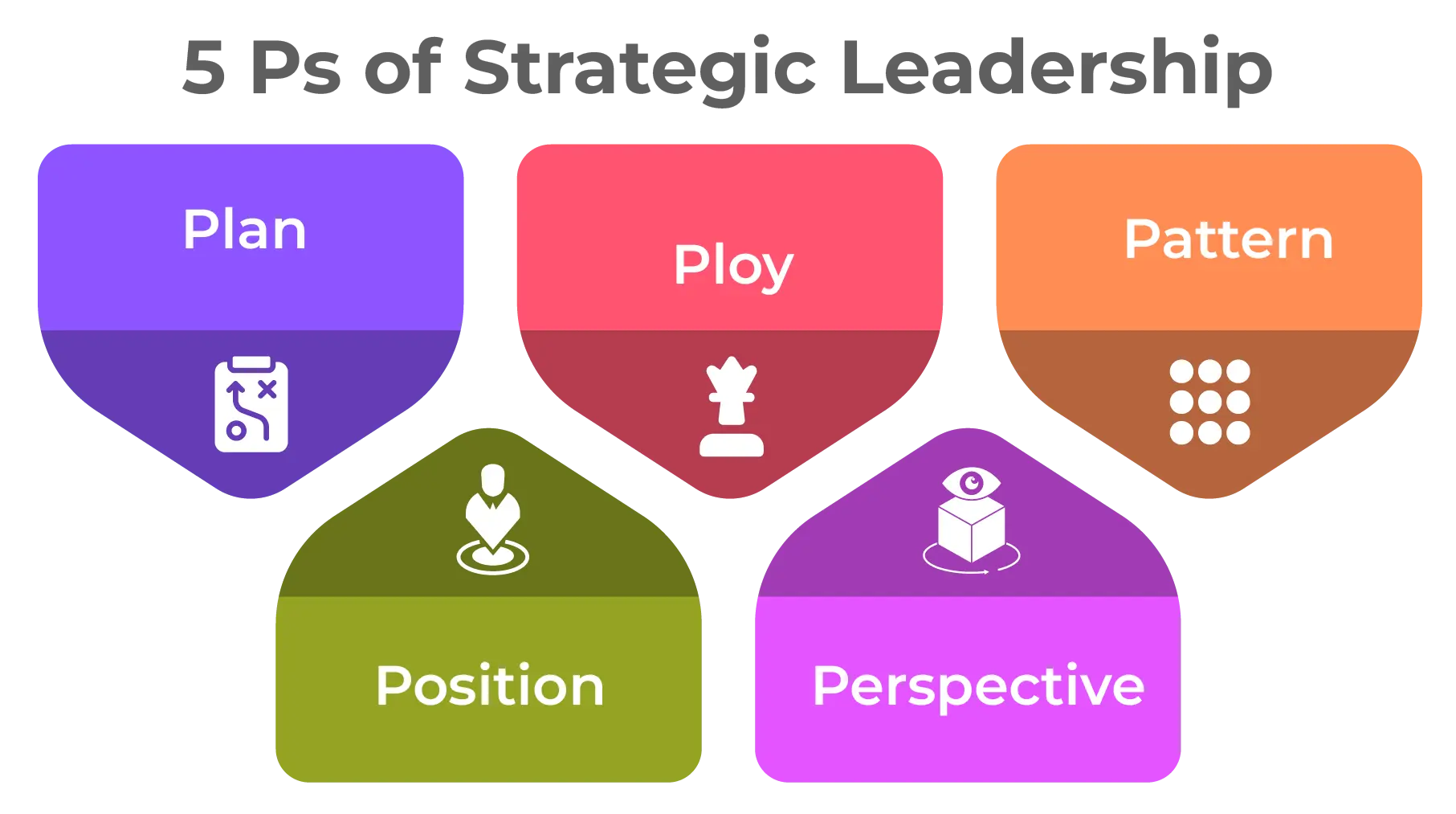
A robust course of action for achieving organizational objectives through goal orientation, resource allocation, decision framework development, change management, risk mitigation, and contingency planning.
A tactic used to outsmart competition through competitor disruption, psychological manoeuvring, deception, or diversion for tactical advantage.
Consistent actions over time that lead to profits, built on consistency, learning, and adaptation to repeat success.
How an organization places itself in the market through differentiation and value proposition to shape customer perception against competitors.
How a company conducts its daily business, shaped by organizational culture, worldview, management mindset, and corporate identity.
Leaders provide their teams with a strategy and help them achieve their objectives using these strategies. They are the ones who should inspire their employees to work harder and ensure the success of their organization. They should provide their team members with the right tools and empower them to work efficiently.
Hence, the role of leaders in strategic management can be branched into:
Leaders are responsible for developing a clear and inspiring vision for their organization’s future. They are also required to guide their staff in the right direction to ensure the fulfilment of this vision.
Leaders should also guide the development of strategies by evaluating internal and external factors in an organization. They should differentiate between opportunities and threats, and make strategic choices for organization success.
Leaders should also ensure that the available resources are effectively allocated to support the implementation of the chosen strategies. Having the right tools and resources results in enhanced performance management, helping the staff undertake their duties well, leading to long-term success. The improved performance can be easily measured using a dedicated performance management system.
They are also required to motivate their employees to embrace new strategies and navigate changes. It helps in the creation of a culture of innovation and continuous improvement within the organization.
Read More:
Effectively communicating the organization’s vision and strategy to all stakeholders also comes under the responsibilities of a leader. They are also required to ensure that their employees’ personal goals are aligned with their organizational objectives.
Leaders should also adapt to changing market conditions and adjust their strategies accordingly. It helps the organization stay competitive, and remain afloat despite any market conditions.
Leaders should also facilitate collaboration between different departments and external partners. It ensures that all stakeholders work together to achieve the organization’s strategic goals, which is ideal for a company’s success.
They are also required to make critical decisions regarding resource allocation, strategic choices, and organizational priorities. Making hard decisions for the benefit of the organization and its employees is a critical skill for leaders.
Conclusion
Strategic leadership is critical for helping any business reach its peak performance and efficiency, ushering it towards the path of sustained success. Hence, companies should have strategic leaders who can make the hard decisions, while ensuring employee satisfaction. It enables the organization to stay competitive in the market, ensuring long-term success.