

The Gallup State of Global Workplace 2026 Report found that only 20% of employees worldwide feel engaged at work. The other 80% are showing up, doing the job, and quietly deciding whether to stay. The engagement difference between these two groups shows much earlier than an exit interview. It shows up in the small signals HR teams miss.
It sets the premise for employee satisfaction surveys sustems, which asks employees directly how they feel about working at the company. It surfaces the ground reality regarding what is working and what is not. Of every method available to HR teams, a well-designed survey remains the fastest way to measure satisfaction across the organisation.
Satisfaction surveys do more than confirm what is going well. Their real value is in catching what is going wrong before it spreads through the organization.
Unhappy employees rarely announce it. Instead, dissatisfaction tends to leak out through gossip, disengagement, and a general resistance to collaboration. Left unaddressed, it becomes a culture problem, because negativity is one of the more contagious things in a workplace. A satisfaction survey gives HR a way to identify where this is brewing early enough to intervene, rather than discovering it during an exit interview.
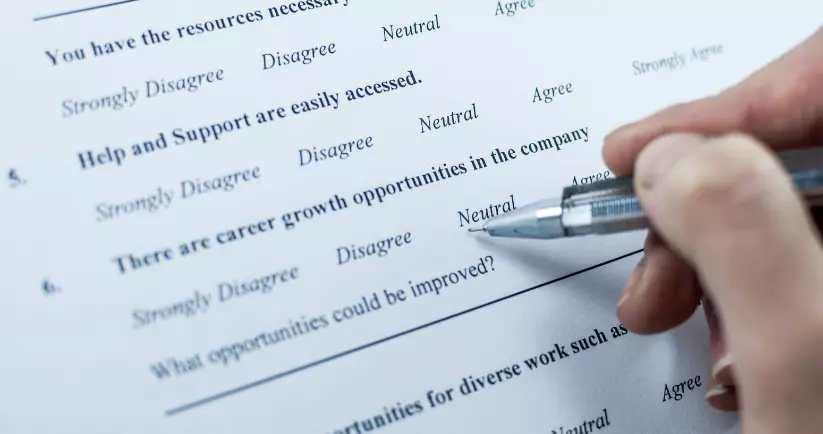
Since employee satisfaction surveys are extremely important for organizations, they should map to the specific factors that drive satisfaction at your company. Here are a few questions that you can use:
You can extend this list to cover job role clarity, performance feedback, and personal accomplishment. There is no fixed template for these surveys; borrow from existing formats and adapt them to your organisation’s specific concerns. Mix response types deliberately: scaled questions for trend tracking, multiple-choice for quick signal, and open text where you need employees to explain in their own words.
Being a direct communication channel with employees, satisfaction surveys deliver:
Employees who never raise a concern in a 1-on-1 may flag it anonymously, whether that is outdated tools slowing them down or a process nobody has questioned in years. More than half of employees choose silence over speaking up, out of fear of being labelled a complainer. Surveys route around that fear.
If you resolve the friction points a survey uncovers, whether that’s unclear priorities, tool gaps, or workload imbalance, productivity tends to follow. It is rarely the survey itself that makes any changes; it is what the organisation does with the data.
Asking for an opinion and acting on it signals that an employee’s voice counts. That single act of being asked, and later seeing a visible response, does more for morale than most engagement initiatives layered on top of it. Pulse surveys work particularly well here because they keep that signal frequent instead of annual.
Send a satisfaction survey early, ideally in an employee’s first few months, and you get an early read on whether expectations match reality. Track this over time and the payoff compounds: lower attrition, less rehiring cost, and more institutional knowledge retained in-house. Combining engagement questions into the same survey gives you both data sets from a single exercise instead of running two.
To plan employee satisfaction surveys effectively, keep these pointers in mind:
Every good survey starts with a specific question the business needs answered. Are you trying to gauge overall satisfaction, or isolate reaction to a recent policy change, like a new leave structure or perk rollout?
The objective shapes everything downstream: question selection, format, even who gets surveyed. Decide this before drafting a single question, as it is the most important part of survey creation.
Annual surveys are a safe bet; however, they are also weak at gathering insights. Employees are subject to recency bias like anyone else, so a once-a-year survey mostly captures how people felt in the two weeks before it landed in their inbox.
Alternatively, employee pulse surveys run more frequently, resolving recency bias. The trade-off to manage is survey fatigue, as too many pulses, too close together, drops response quality along with response rates.
The survey format needs to match your objective and your audience. Question sequence matters more, as a poorly ordered survey makes employees second-guess what is being asked, which shows up as inconsistent or rushed answers. Keep the language simple. Precision matters more than polish here.
A brilliantly designed survey that nobody completes tells you nothing. Anonymity matters here, and so does communicating it clearly, since employees who doubt confidentiality tend to answer defensively or not at all.
Additionally, send reminders. Use every channel available, from company email to the self-service portal news board. Some companies add small incentives to push completion rates higher; although optional, it works.
This is the step most companies skip, and it’s the one that determines whether the next survey gets taken seriously. Share what the survey found, and share what you are doing about it, whether that’s over email or a dedicated presentation.
Acting visibly on feedback is what converts a dissatisfied employee into a satisfied one. Skip this step, and the next survey you send will get lower participation, because employees remember when their input went nowhere.
Here are the common mistakes to avoid while creating an employee satisfaction survey for your organization:
Conclusion
Employee satisfaction and engagement move together, and both directly affect organisational productivity. Get the objective right, keep the survey simple and inclusive, push hard for responses, and, most importantly, act visibly on what you learn. Following these points will ensure the success of the survey as well as long-term improvement in your employees’ job satisfaction and engagement with your company.