


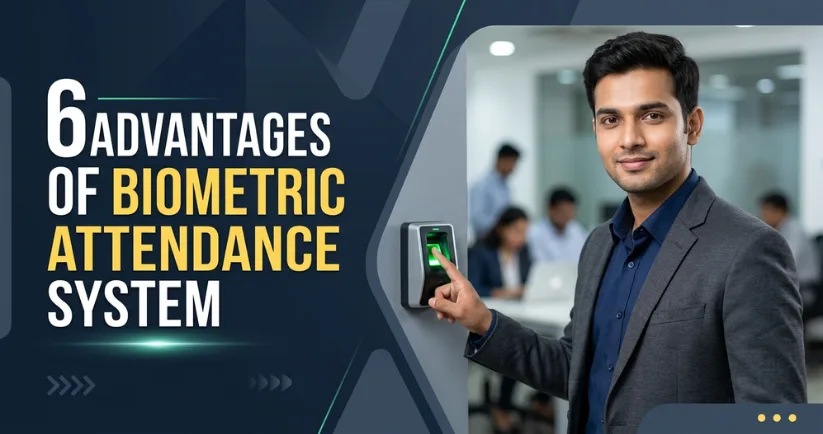
Managing employee attendance may seem like a routine HR task. However, inaccurate attendance records can lead to payroll errors, compliance issues, productivity losses, and employee disputes. Additionally, traditional attendance methods such as manual registers and swipe cards often leave room for mistakes and misuse.
On the other hand, deploying a biometric attendance system makes a significant difference. By using unique biological identifiers such as fingerprints or facial recognition, businesses can record attendance accurately and automate workforce management processes.
So, let us explore the key advantages of biometric attendance systems and why they have become an essential tool for Indian businesses.
A biometric attendance system is a technology-based solution that records employee attendance using unique physical characteristics. Unlike passwords, PINS, or access cards, biometric data cannot be easily shared or duplicated.
The common types of biometric attendance systems include:
When an employee clocks in or out, the system verifies their identity and records the attendance instantly. Modern biometric systems can also integrate with HRMS and payroll solution, making attendance management more efficient.
Here are 6 of the major advantages of deploying a biometric attendance system in your organization:
One of the biggest challenges with traditional attendance methods is buddy punching, where one employee marks attendance on behalf of another. This can lead to inaccurate records and unnecessary payroll expenses.
Biometric attendance systems eliminate this issue by requiring the physical presence of the employee. Since fingerprints and facial features are unique to each individual, attendance can only be marked by the actual employee. Having this option helps organizations reduce time theft, improve accountability, and maintain workplace discipline.
Manual attendance records are prone to human errors, including incorrect entries, missed punches, and duplicate records. These inaccuracies often create additional work for HR teams during payroll processing.
A biometric attendance system records attendance in real time and stores it digitally. This ensures accurate clock-in and clock-out records while reducing dependency on manual corrections. Accurate attendance data also helps managers make better workforce decisions based on reliable information.
Attendance directly impacts payroll calculations. Inaccurate attendance data can result in salary disputes, incorrect overtime calculations, and compliance challenges.
Modern biometric attendance systems integrate seamlessly with payroll software to automate calculations related to:
For Indian businesses, this integration is particularly valuable as it helps maintain accurate records that support payroll compliance and statutory calculations.
HR teams often spend considerable time collecting attendance data, verifying discrepancies, preparing reports, and answering employee queries.
With biometric attendance systems, these tasks become largely automated. Attendance data is captured instantly, and reports can be generated within minutes. As a result, HR professionals can spend less time on administrative work and focus more on strategic initiatives such as employee engagement and workforce planning.
Modern organizations often operate across multiple offices, branches, stores, or project locations. Tracking employee attendance manually across different locations can be difficult.
Biometric attendance systems provide real-time visibility into workforce attendance. HR teams and managers can instantly view:
This visibility improves operational planning and helps managers respond quickly to staffing requirements.
Maintaining accurate attendance records is important for internal audits and workforce management practices.
Biometric systems create secure digital records that are easy to access whenever required. Detailed attendance logs, approval histories, and reports help organizations maintain transparency and improve recordkeeping. These digital records also reduce the risk of lost or manipulated attendance data.
Indian organizations often manage large workforces, multiple locations, shift-based operations, and diverse attendance policies. Industries such as manufacturing, retail, logistics, healthcare, education, hospitality, and IT require reliable attendance tracking to ensure smooth operations.
A biometric attendance system helps these organizations standardize attendance management, reduce manual intervention, and improve workforce accountability across locations. Whether a company has 50 employees or 5,000, accurate attendance tracking becomes essential for maintaining productivity and operational efficiency.
Here is a simple table demonstrating the difference between traditional and biometric attendance methods:
| Method | Limitation | Suitability |
|---|---|---|
| Manual Register | Human Errors & Manipulation | Small Teams |
| Swipe Card / RFID Card | Card-sharing | Basic Access Control |
| Biometric Attendance | Accurate Verification | All Businesses |
| Geofencing-based Mobile Attendance | Mobile Access Requirement | Field Workforce |
While biometric attendance systems offer many advantages, organizations should also pay attention to employee privacy and data security. To stay compliant with the Digital Personal Data Protection (DPDP) Act, businesses should:
A transparent attendance policy helps build employee trust while ensuring responsible use of biometric technology.
Like any technology, you may encounter some challenges while deploying a biometric attendance system, such as:
However, many modern solutions address these challenges through face recognition technology, mobile attendance options, cloud backup, and offline synchronization capabilities.
Before investing in a biometric attendance solution, businesses should evaluate:
Selecting a solution that aligns with your workforce requirements will ensure long-term value and smoother adoption.
The advantages of a biometric attendance system go far beyond simply recording employee attendance. From preventing buddy punching and improving payroll accuracy to enhancing workforce visibility and reducing administrative workload, biometric technology helps businesses build a more efficient and accountable workplace. For Indian organizations looking to modernize their HR operations, a biometric attendance system integrated with an HRMS can be a valuable investment that improves productivity, compliance, and employee experience.
The main advantages of a biometric attendance system include improved attendance accuracy, prevention of buddy punching, reduced payroll errors, real-time tracking, and automated attendance management.
Yes, most modern biometric attendance systems can integrate directly with payroll software to automate salary calculations, overtime, leave deductions, and attendance processing.
Absolutely. Cloud-based biometric attendance solutions are seamlessly scalable according to the company’s growth, and hence, they can be used by startups, SMEs, and large enterprises alike.
If fingerprint attendance fails, modern biometric systems provide alternative options such as facial recognition, PIN-based authentication, mobile attendance, or administrator-assisted attendance marking.
When implemented correctly, biometric attendance systems use encryption, access controls, and secure storage practices to protect employee data and maintain privacy.