

Irrespective of the industry human resources play an important role in the growth of the business. The challenges in the manufacturing industry are constantly changing. The industry has faced challenges such as wage regulation and sanitary work conditions. Over time the challenge evolved and turned into a struggle to match the growth with technological developments and employee engagements.
On the one hand, the industry has to match and keep pace with the revolution in technology while on another hand they struggled with stagnancy for two years of pandemics. Most manufacturing units either have been shut down due to lockdown or were at least operating at a limited capacity due to safety guidelines.
In addition to the above conditions, pandemic-driven increased demands on most products while the supply chain is still recovering. A combined effect of all this not only has increased pressure on the manufacturing industry as a whole but indirectly increased HR challenges in the manufacturing industry, making HRMS software a necessity in this sector.
In this blog, we will try to understand these challenges in the manufacturing industry and the possible solutions for the industry.
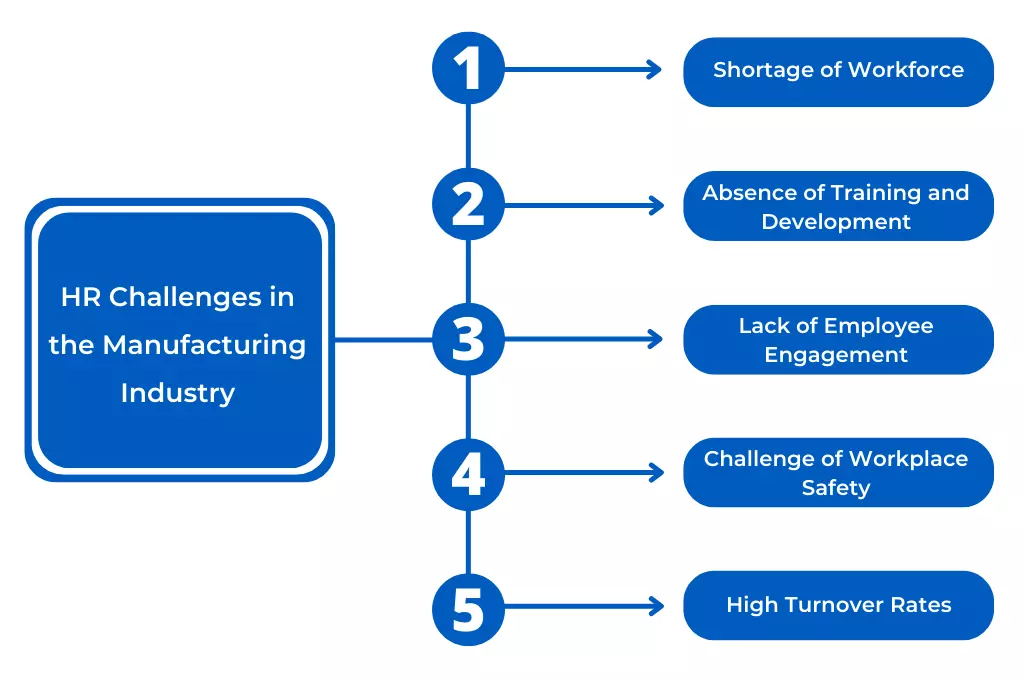
Recruitment is one of the most challenging tasks among the top HR challenges in the manufacturing industry. The process requires a lot of investment in terms of time, money, and effort as well.
There is a constant shortage of skilled workforce. The companies need skilled engineers and technicians working in various departments on the ground. Whereas the nature of the work makes it difficult for human resources to find the right candidate for the role.
A traditional approach to recruitment in the manufacturing sector makes it even more difficult to hire top talent. A manufacturing company often comes with budget constraints for the hiring process. That leaves HR with a short supply of candidates who have the right skills and experience for the position.
The manufacturing industry still didn’t yet adapt the option of campus recruitment. That makes it challenging to hire new talent entering the workforce who do not see the sector as an attractive career option.
The manufacturing industry still relies on newspaper recruitment ads and the many other forms of print media to inform people about the vacancy. The print media was a good source for job seekers mostly baby boomers and the workforce is retiring now. The hiring process also becomes tiring for the employees as it involves multiple unorganized interview rounds and tests. Many employees drop out from the hiring process as it expands for longer durations.
The manufacturing industry needs to take a few steps to solve the challenge in recruitment. Some of these solutions are listed below.
It’s observed that most of the workforce in the manufacturing industry is dominated by the baby boomers. They have the necessary work experience but they are approaching retirement and are about to be out of the workforce.
Rapid advancement in technology asks for workers who can be flexible and learn to operate the new machinery quickly as that is important for increasing the productivity of the company.
The manufacturing sector is looked at as boring and unattractive. The lack of marketing or branding makes manufacturing jobs unappealing to the young workforce. To keep the manufacturing sector profitable organizations need to train the workforce to use the technology.
Employee experience is likely to fail to support their productivity if they lack the skills to use newer machinery and eventually lose to their competition. With the continuous development in technology, it’s not wise to fire the old staff and hire the new ones who know how to use the newer technology. With the workforce shortage that the manufacturing sector is facing, constant hiring won’t be feasible.
The high turnover rates in manufacturing companies are one of the top HR challenges in the manufacturing industry. The lack of a skilled workforce has been a long-standing issue and the high turnover rates magnify the shortage of talent by the need for repeated hiring. The absence of employee engagement has been one of the most significant reasons for the high turnover rates.
With the right employee engagement strategy and a robust HR management system, the manufacturing industry can be taking advantage of the increase in productivity. The manufacturing industry is labor oriented and can be hard for the work-life balance of the employees as well.
The HR challenges in the manufacturing sector do not end at the training and development after the onboarding. The workplace has to be engaging and supportive according to needs and the challenges that employees face in their daily life. The work culture and employees’ relationship with their peer plays an important role in employee engagement.
Workers in the manufacturing industry are always operating with the risk of getting hurt by the nature of their work. As the sector is the most labor-intensive one and work involves several health risks as they are exposed to the chemicals.
The manufacturing sector also has a high rate of risk to the physical health of the employees as well, as workers typically work with machines. Operating machinery has a risk of accidents due to human or mechanical errors.
Often employees have to climb on a ladder or will be positioned on a high platform to perform the tasks that are part of their daily activities. Falling down from height is also a leading cause of injuries in the manufacturing industry. There are other forms of health issues that employees develop over time such as breathing issues, difficulty in hearing, and many more due to exposure to hazardous chemicals and constantly working in noisy environments.
Retaining the employee can be much more important than hiring them in the first place. In the manufacturing industry if employees keep leaving their job within a few months the repeated recruitment can be very tiring for HR and expensive for manufacturing companies. The industry faces challenges that make it difficult for them to find the right talent. But the hr departments in the industry also have to tackle the issue of attrition.
Employees find it easy to leave their manufacturing jobs to grab other lucrative opportunities. The old fashion work environment with low engagement as well as labor-intensive work and the physical risks adds to the reasons for employees to leave their jobs.
The manufacturing industry also needs to minimize the physical work and simplify the processes. The constant expectation for higher productivity in absence of supporting tools and technology makes it physically and mentally stressful for employees to be working in the industry.
In addition to all the work-related issues, there are often budget concerns and a lack of benefits. Most policies concerned with the employees focus on productivity and not well being of the employee. For the employees that work in the sector, a lack of growth and job security, further adds to the turnover rate.
HR in manufacturing faces challenges from recruiting to retaining talent. The industry should adapt to new age trends of hiring with the help of digital media to find the right talent. There should be constant emphasis on upskilling the workforce and helping them grow in their personal and professional fields. The safety and security of the employees at the workplace have been great challenges and the industry needs newer training and policies to ensure employee safety. Human resources need to form engaging workplaces, benefits, and policies that encourage work-life balance to attract new talent to the manufacturing industry.