

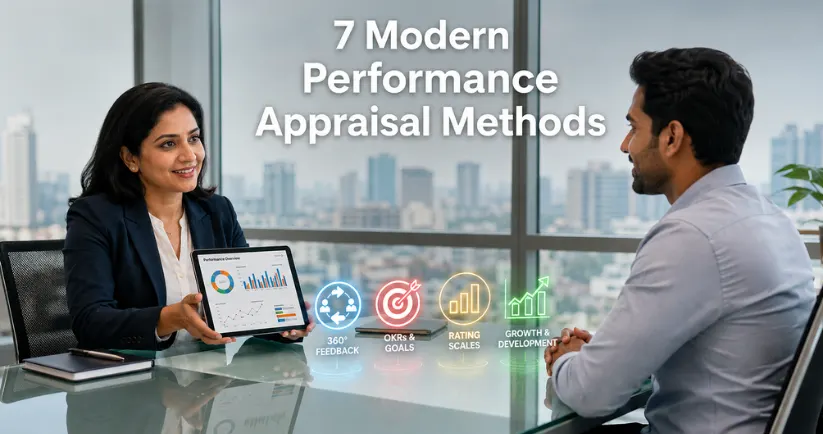
Performance appraisal has evolved well beyond annual rating exercises. Modern methods deliver real-time Feedback, measurable outcomes, and complete employee development. The right appraisal method directly shapes engagement, retention, and business growth.
Here are the 7 most effective modern performance appraisal methods organizations use today.
Here are the 7 most widely used modern performance appraisal methods, each suited for different organizational needs:
360-degree feedback is an appraisal method where an employee is evaluated by their managers, peers, subordinates, and clients to provide a holistic view of performance.
360-degree performance appraisal method reduces the risk of biased reviews by gathering input from multiple stakeholders. It gives a well-rounded picture of an employee’s skills, behaviours, and effectiveness across different relationships. HR teams also use this method to identify training needs and succession planning gaps.
OKR-based appraisal evaluates employee performance against Objectives and Key Results (OKRs) to fulfil measurable, time-bound goals set collaboratively by the employee and their manager.
The OKR framework shifts the focus from effort and personality to outcomes and impact. ‘Objectives’ define what the employee aims to achieve, while ‘Key Results’ are quantifiable milestones that track progress. Appraisals based on OKRs are transparent, data-driven, and closely tied to business priorities.
Additionally, the ratings reflect actual goal achievement rather than subjective assessments, making this one of the most objective modern appraisal methods available.
Psychological appraisals evaluate an employee’s future performance potential by assessing cognitive abilities, emotional intelligence, interpersonal skills, leadership traits, and personality characteristics.
Psychological appraisals focus less on what an employee has done and more on what they are capable of achieving. Organisations typically use this method to identify high-potential employees for leadership roles or to build succession pipelines. The process involves structured assessments, psychometric tests, and one-on-one evaluations conducted by a qualified psychologist.
Management by Objectives (MBO) is a collaborative appraisal method where managers and employees jointly set, monitor, and evaluate specific performance goals within a defined timeframe.
Under MBO, goals are validated using the SMART criteria: Specific, Measurable, Achievable, Realistic, and Time-bound. Managers review progress periodically and assess the feasibility of goal completion. Employees are evaluated on results, and those who meet or exceed their goals receive salary increments or promotions. The method is constructive by design, aimed at improving performance via training management system rather than penalising shortfalls.
Read More: Management By Objectives (MBO): A Comprehensive Analysis
The Assessment Centre Method is a structured evaluation method where employees participate in simulated exercises, role-plays, and group activities to assess their current performance and predict their future job suitability.
Originally developed in 1930 and updated for modern workplaces, the Assessment Centre method is primarily used to evaluate supervisors and senior executives. Employees complete a series of exercises, including case studies, group discussions, in-tray activities, and role-playing scenarios that mirror actual job demands. Senior management, HR, and psychologists review the results collaboratively and provide feedback on strengths and development areas.
BARS is an appraisal method that uses specific behavioural descriptions tied to numerical rating scales, enabling objective and consistent evaluation of employee performance against predefined job-specific standards.
BARS combines qualitative and quantitative evaluation to produce more accurate and equitable appraisals. The process involves 5 steps:
Because ratings are anchored to observable behaviours specific to each role, this method significantly reduces reviewer subjectivity.
The Human Resource Accounting Method is a performance appraisal method that measures an employee’s value to the organisation by calculating the monetary benefits they generate relative to their cost of employment.
HR Accounting method evaluates performance through a financial lens. It factors in elements such as output quality, interpersonal relationships, overhead costs, and the employee’s overall contribution to revenue. While this method provides a precise economic view of employee value, it demands strong analytical capabilities from reviewers and access to reliable financial data.
Organisations use these seven methods to evaluate employee performance and generate meaningful feedback. Many companies also define these methods within their performance management system, so employees understand the evaluation criteria, performance expectations, and review process, enabling them to perform accordingly.
Here is a table comparing all 7 methods at a glance, which will help you identify the best fit for your organisation:
| Method | Best For | Feedback Source | Time Intensity | Bias Risk | Future-Focused |
|---|---|---|---|---|---|
| 360-Degree Feedback | All employee levels | Peers, managers, clients | Medium | Low | Yes |
| OKR-Based Appraisal | Goal-driven teams | Manager + self | Low | Low | Yes |
| Psychological Appraisals | Leadership pipeline | Psychologist + manager | High | Low | Yes |
| Management by Objectives | Mid-level & senior roles | Manager | Medium | Medium | Yes |
| Assessment Centre | Supervisors & executives | Multiple evaluators | High | Low | Yes |
| BARS | Role-specific evaluation | Manager | Medium | Low | No |
| HR Accounting Method | Financial performance review | Accounts + HR | Low | Medium | No |
Modern performance appraisal methods replaced traditional ones because the old model measured the wrong things at the wrong time. Traditional appraisals ran once a year, where after manager evaluation, the employee only received the outcome. Rating twelve months of work from memory invited recency bias and the halo effect. Paper forms and rigid templates judged every role by the same sheet. The focus stayed on past performance and personality traits, and the review ended at a salary decision. Nothing told the employee what to do next. Modern methods come as a company-employee lifesaver. The methods overcome these limitations by emphasizing employee achievements, future potential, and real-time Feedback. They make the appraisal process more transparent, objective, and actionable.
According to Gallup’s Re-Engineering Performance Management Research paper, only 21% of employees believe that their organization has the performance metrics under control. Hence, it is evident that no single appraisal method suits every organization. The right choice depends on your workforce size, industry, budget, and performance goals. Many organizations combine two or more methods. For example, pairing MBO with 360-degree Feedback helps the HR team get a more complete picture.
Hence, consider the following when making your decision:
Large teams benefit from structured methods like BARS or 360-degree Feedback. Smaller teams can adopt MBO or OKR-based appraisals with less administrative overhead.
Technical or sales roles with measurable output suit OKR-based or HR Accounting methods. Leadership or cross-functional roles benefit from 360-degree feedback or Assessment Centre evaluations.
Modern approaches recommend quarterly check-ins alongside a formal annual or bi-annual appraisal cycle. Such check-ins enable the company to let the employee know whether they are fulfilling the requirements of their role, and take corrective measures, if required.
Psychological appraisals and Assessment Centres require significant investment. OKR-based and MBO methods are cost-effective alternatives.
Conclusion
Each of the 7 modern performance appraisal methods has its strengths and limitations. The right method for your organization depends on your industry, workforce size, and performance objectives. Many organizations find success in combining methods rather than relying on a single approach.
What matters most is consistency, fairness, and a genuine intent to develop your workforce. Pair your chosen method with a capable HRMS platform like Pocket HRMS, and your appraisal process becomes a strategic advantage rather than an administrative burden.
The 7 modern performance appraisal methods are 360-degree feedback, OKR-based appraisal, psychological appraisals, management by objectives, assessment centre method, Behaviourally Anchored Rating Scales (BARS), and human resource accounting method.
Traditional methods focus on past performance and personality traits using ratings and rankings. On the contrary, modern methods emphasise measurable goals, real-time feedback, and employee development, making appraisals more objective, forward-looking, and actionable for both organisations and employees.
The best modern performance appraisal method depends on your organisation’s size and goals. While 360-degree feedback suits large teams, MBO works well for goal-driven organisations. Similarly, BARS fits a role-specific evaluation. Hence, many Indian companies combine two or more methods for a more comprehensive review.
360-degree feedback is a performance appraisal method where an employee is evaluated by their managers, peers, subordinates, and sometimes clients. It provides a well-rounded, multi-perspective view of performance while significantly reducing the risk of biased evaluations.
OKR-based appraisal evaluates employees against Objectives and Key Results. It involves setting measurable, time-bound goals jointly by the employee and manager. It focuses on outcomes over effort, making it one of the most transparent and data-driven modern appraisal methods available.
BARS uses specific behavioural examples anchored to rating scales, making evaluations accurate and role-specific. Unlike general rating methods, BARS measures only observable, job-relevant behaviours, which significantly reduces reviewer subjectivity and ensures greater fairness across evaluations.
Most organisations run formal appraisals annually or twice a year. However, modern best practice recommends frequent check-ins paired with continuous feedback loops for better goal alignment, faster course correction, and improved employee engagement throughout the year.