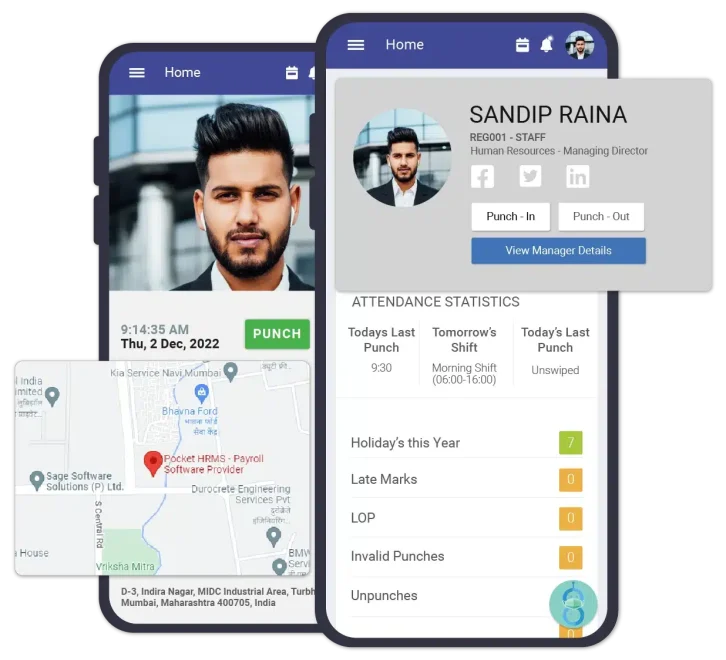
A GPS-based Attendance System is software that helps you track your employees’ daily attendance utilizing GPS hardware. Being an automated system, it is highly accurate and secure. By deploying GPS-based Attendance Software, you can efficiently manage the attendance and working hours of your remote staff, making it a feasible solution for startups to MNCs. It is highly reliable, cost-effective, and intuitive, eliminating manual, error-prone attendance ledgers.
Automated GPS Attendance Tracking System with Enhanced Features
Custom Reporting
Develop customized reports by selecting each parameter, defining the date range, and selecting the format for periodic reports.
Timely Updates
On-time notifications help managers approve or reject applications and notify the employees of their request updates.
Advanced Rosters
Create and manage advanced attendance rosters for enhanced efficiency with minimal manual input.
#1 Choice of Industry Experts
Happy Clients
15+
Smart HRs
0+
Satisfied Users
0M+
"Pocket HRMS provided a comprehensive and customizable solution that truly streamlined our HR processes, which has been a significant benefit to our employees.
"Our HR efficiency was enhanced by Pocket HRMS. Innovative features like 'smHRt searcHR,' automated payroll, and the mobile app boosted employee engagement."
"Our HR efficiency was enhanced by Pocket HRMS. Innovative features like 'smHRt searcHR,' automated payroll and the mobile app greatly improved the employee experience."
"Our HR operations were revolutionized by Pocket HRMS. Its innovative AI-driven automation, error-free smHRt® Payroll, and smHRt searcHR® have been genuinely transformative."
"Pocket HRMS revolutionized our HR operations. Automated payroll, seamless attendance, and a user-friendly mobile app have been key to our team's positive adoption."
"Upgrading from spreadsheets to Pocket HRMS was a game-changer. It streamlined our workforce management with automation, accuracy, and and AI-driven insights."
A GPS-based Attendance System uses the GPS sensor on an employee’s smartphone to capture their location during check-in or check-out. The system compares the location with predefined attendance zones or geofences and records attendance when the employee meets the configured rules. This automates attendance and helps avoid manual entries.
Can a GPS Attendance System track employee locations?
Yes, a GPS attendance system can capture an employee’s location when GPS-based tracking is enabled. Depending on the system configuration, businesses can use geotagging to record the location associated with attendance and geotracking to monitor approved employee locations. Employers should clearly communicate the purpose and scope of location tracking to employees.
Can GPS Attendance be used for remote and field employees?
Yes, GPS attendance is highly useful for remote and field employees who do not regularly work from a fixed office. Employees can use their smartphones to mark attendance, while the system captures location information to verify where the attendance was recorded. This helps businesses manage distributed teams without relying on physical attendance devices.
What is geofencing in a GPS Attendance System?
Geofencing creates a virtual geographic boundary around a predefined location, such as an office, project site, or work location. In a GPS Attendance System, the configured geofence can be used to restrict or validate attendance based on an employee’s location. This helps businesses ensure that employees mark attendance from approved locations.
Can employees mark attendance using GPS on their mobile phones?
Yes, employees can mark attendance through a mobile app that uses their smartphone’s GPS sensor to verify their location. Depending on the attendance policy, the system can combine GPS with geotagging, geofencing, or other verification methods. This makes mobile GPS attendance suitable for remote, hybrid, and field-based employees.
Can a GPS Attendance System prevent attendance fraud and buddy punching?
A GPS Attendance System can help reduce attendance fraud by associating an attendance punch with the employee’s location and configured attendance rules. When combined with features such as geofencing, facial recognition, or device-based verification, it can make unauthorized attendance marking more difficult and provide HR teams with more reliable attendance records.
Is GPS Attendance secure and compliant with employee privacy requirements?
GPS attendance involves collecting employee location data, so businesses should establish clear policies for its use. Employees should be informed about what location data is collected, why it is collected, when tracking occurs, and how the data is handled. Organizations should also follow applicable privacy and data-protection requirements when implementing GPS-based attendance.
Why should you avoid manual attendance tracking?
As it is undertaken manually, manual attendance tracking can have human errors. It can also lead to malpractices like buddy-punching, as it is harder to manage. It is a time-consuming process as it requires the HR teams to organize paper trails and physical storage. Compliance handling also remains sketchy when it is undertaken manually.