
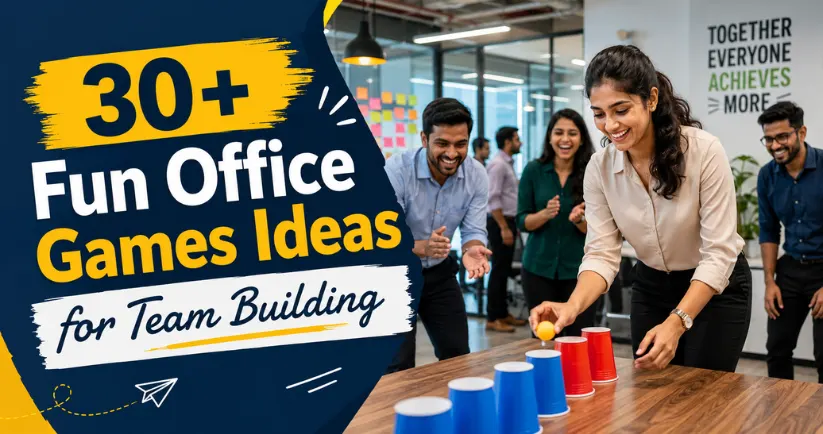
Office games are structured workplace activities that HR can organise to keep employees engaged and reduce stress during working hours. Well-planned games also strengthen team collaboration and support employee retention. When HR introduces creative, engaging office games, it breaks the monotony of daily work and encourages employees to interact, collaborate, and build stronger relationships with colleagues and managers.
When HR involves leadership in these activities, participation from the top enhances trust and strengthens employer-employee relationships across the organisation. This blog covers the benefits of office games, game ideas HR can organise for teams of every size, and practical tips HR can use to implement them successfully.
Here are fun game ideas HR can organise for the office. Each one is easy to implement, simple to explain, and enjoyable for everyone. From quick icebreakers to team challenges, HR will find something suited to every workplace:
The HR team can turn a Friday into something energetic and fun-loving by organising a guessing game. The format is simple: HR collects handwriting samples from colleagues across every team, shuffles the chits, and asks employees to pick one and guess whose handwriting it is. The team that identifies the most correctly wins.
HR does not need to stick to handwriting alone. The same format works with random personal items collected from colleagues, with employees guessing whom each item belongs to. HR teams can manage the nomination process by circulating a list of employee names beforehand.
Clay pot making is a trending DIY activity, and HR can organise a pot-making event with a twist by introducing a crooked pot challenge to liven up an otherwise routine Friday. To plan this, HR can book a pot-making specialist and arrange tools such as wheels and scalpels. HR can schedule the session over a weekend or at month-end, as employees tend to enjoy the crooked pot challenge more than a standard pottery session.
The freeze challenge works well as part of an office party. A monotonous work schedule often leads to disengagement, so HR can arrange a weekend lunch and plan the freeze challenge around it. Calling the freeze command without warning, so everyone holds a candid frozen pose, adds an element of surprise that makes the Friday session more memorable.
Potluck lunches have become common, with most offices celebrating one at least once a year. HR can add a twist to the usual potluck by turning it into a tea-making competition, where employees prepare different varieties of tea and colleagues vote for their favourite. The tea that receives the most votes wins.
This is one of the easiest office games for HR to organise, since it needs no props or dedicated event. HR plays a comedy clip or series and instructs employees not to laugh. For an added layer of difficulty, HR can ask participants to hold water in their mouths while watching. For a more elaborate version, HR can bring in a comedian to host the challenge live.
A balloon-blowing competition is cost-effective and works well when HR wants a short, contained activity rather than a full day of planning. HR can run this game for up to an hour to lift employee spirits.
To add a competitive edge, HR can set a timer for each balloon, such as 10 seconds per balloon or 60 seconds for a set of 10, and divide employees into teams to see which team blows the most balloons within the time limit.
Quick Desk Games are fast-paced activities HR can organise to energise employees during short breaks. Each participant receives a prompt or mini task, such as mimicking an emoji, answering a quirky question, or solving a riddle, and must respond within 30 to 60 seconds, right at their desk.
This format encourages spontaneity, boosts creativity, and adds a playful burst of energy to the workday. HR can use it for team bonding without disrupting workflow.
Charades is a classic office game HR can organise to bring laughter and teamwork into the workplace. Participants take turns acting out words or phrases, often tied to movies, office jargon, or popular culture, without speaking, while teammates guess within a time limit. It encourages non-verbal communication, quick thinking, and collaboration.
HR can slot Charades into team-building sessions or casual breaks. Either way, it lightens the mood and sparks creative engagement among employees.
The Code of Conduct Game gives HR a way to help employees understand workplace rules and ethics through a format that does not feel like traditional training.
Instead of a lecture, HR can design role-play scenarios, multiple-choice quizzes, or scenario-based challenges where participants identify the correct behaviour or resolve an ethical dilemma. Teams earn points for correct answers, turning policy learning into a competitive, collaborative exercise. The game reinforces company values and compliance standards while opening up conversation around workplace behaviour, making the experience memorable.
Name That Tune is an interactive game HR can organise for remote teams to build spirit and light-hearted competition. To run it, HR prepares a playlist of short audio clips, preferably instrumental or just the opening beats, to keep the round challenging. HR then gathers everyone on a video call, plays each clip, and lets participants guess the song. HR can run it individually or split the team into two groups for a more structured format, awarding points for each correct answer, with the highest scorer or team declared the winner.
To keep energy high, HR can offer a small prize or digital gift voucher to the winning team. This is a simple way to break the monotony, boost morale, and create a shared moment of joy even when the team is distributed.
Read More: 30+ Team Building Activities for Employees
Well-run team games do more than refresh employees’ minds. They build transparency and strengthen the employee-employer relationship. Here are the top team-building games HR can arrange, grouped by format:
The games above work through the week, and HR can also set aside a few formats reserved specifically for Fridays:
Inspired by Family Feud, this game uses workplace and weekend-themed questions, with employees competing to guess the most popular answers chosen by their colleagues in a survey. It encourages teamwork, laughter, and friendly competition before the weekend begins.
HR asks employees to dress as if they were heading straight into their weekend plans. HR can add a monthly theme to keep the format fresh and set aside time for employees to share what their weekend actually looks like.
The HR team can organise a quick karaoke session with solo or team performances. Employees vote on categories like Best Performance, Most Energetic Singer, or Crowd Favourite, which keeps everyone involved even if they are not singing.
HR personnel set up a short quiz where employees guess popular movies or TV shows from emoji clues alone. Setting a timer for each round and awarding points to the fastest team keeps the pace competitive.
HR creates a wheel with challenge options such as:
HR displays childhood photos or blurred desk photos and asks employees to guess whose they are. It is a simple way for employees to learn interesting facts about their teammates and spark conversation across teams that do not usually interact.
HR hides small treats or gift cards under a few desks and drops clues throughout the day. The surprise element keeps employees engaged and adds a bit of excitement to an otherwise ordinary workday.
An office treasure hunt gives HR a fast-paced Friday activity built around clues hidden across the workplace. HR can design team-based challenges within the hunt to encourage collaboration and problem-solving along the way.
This format takes more time to set up, but HR can turn it into a strong Friday closer. HR plays a few seconds of a popular song, and teams compete to complete the lyrics.
Here are practical tips HR can use to avoid the common mistakes that derail office games:
Before HR commits to a trending format, it helps to understand the team’s interests, demographics, and comfort zones. HR should pick games that work across personality types rather than favouring one group.
HR should define why the game is being organised. Whether the goal is team bonding, stress relief, a creativity boost, or an onboarding icebreaker, the objective should shape the format HR picks.
HR needs to decide when and how often to run these games. Most organisations run a game at the end of every week or twice a month, though HR can schedule shorter refreshers mid-week if needed.
Last-minute games rarely land well. HR should communicate the date, time, and format well ahead of the session, along with clear rules shared with the team beforehand.
HR should avoid designing games so complex that employees spend the entire day playing instead of working. Games should be accessible to everyone regardless of department, seniority, or role.
Not every employee wants to join a game, and HR should treat participation as voluntary rather than mandatory. Encouraging involvement works better than forcing it.
Final Thoughts
Office games accelerate employee engagement and boost satisfaction. For HR, they are a practical way to strengthen team collaboration, reduce workplace stress, and support employee retention. Even short, well-planned activities help employees build stronger relationships, communicate more effectively, and approach challenges with more creativity and confidence. Whether the organisation is small or large, in-office or remote, HR that picks the right office game ideas will build a more positive work culture without hurting productivity.