


Mismanaged shifts are often the cause of employee burnout. While manual attendance systems may work for your organization, they become a liability once you factor in overtime tracking and chaotic shifts. Since these systems rely on human calculations and manual entries, they often lead to payroll errors and burnout. Combine it with the growing number of employees, and you have a recipe for disaster.
On the other hand, deploying attendance software is the smarter alternative, as it allows for increased automation, resulting in streamlined overtime and shifts. So, let us understand how to handle overtime and shift management with attendance software to bring control, fairness, and transparency to your workforce scheduling.
The modern workplace requires flexible shifts, remote working, and in some cases, longer working hours to ensure the completion of projects on time. However, this results in added pressure on the HR teams along with the employees, as they are required to make last-minute shift swaps, regularize attendance discrepancies, and calculate employee overtime, while maintaining compliance with the statutory regulations.
So, before we dive into automation, let us understand the challenges in modern workforce management:
While flexible and hybrid working have become common in the post-pandemic era, it has also led to increased shift management challenges for HR teams. With flexible shifts, allocating exact timings for employee shifts becomes a challenge for HR, while ensuring the accuracy of remote attendance capture is another major issue.
In the absence of well-defined shifts, employees can take unnecessary overtime as businesses start relying on it to meet sudden demand in manpower, such as during specific business hours. However, without attendance software, HRs cannot track such overtime, leading to unbudgeted labour costs and employee burnout.
Similarly, physical ledgers and spreadsheets used for manual attendance tracking often prove ineffective in avoiding attendance errors. Missed entries, fraudulent transactions, and other inaccuracies lead to loss of working hours, as well as incorrect salary payments, resulting in employee disengagement. Additionally, these manual methods do not provide real-time manpower visibility to managers, making it hard to track productivity.
Without an automated shift management system in place, managers may allocate uneven shifts to their staff members, leading to morale issues among them. It can also result in unrecorded overtime, which leads to resentment among the staff, leading to increased attrition. Manual shift allocation can also feel rigid, especially when there are no shift swap options, leading to further disengagement.
Moreover, Indian labour laws have set well-defined limits on employees’ daily and weekly working hours, along with breaks, overtime, and other associated factors. When you record employee attendance manually, ensuring compliance with these laws becomes tricky, as you cannot be sure of the accuracy of your attendance records.
Attendance software provides enhanced attendance automation, resulting in the capture of exact working hours and secure, foolproof records. Deploying an attendance management system results in increased data transparency, which also helps capture exact overtime information, which translates to correct payouts. Hence, we have developed a list of the best attendance management software for you.
For now, let us understand the role of attendance software in overtime and shift management:
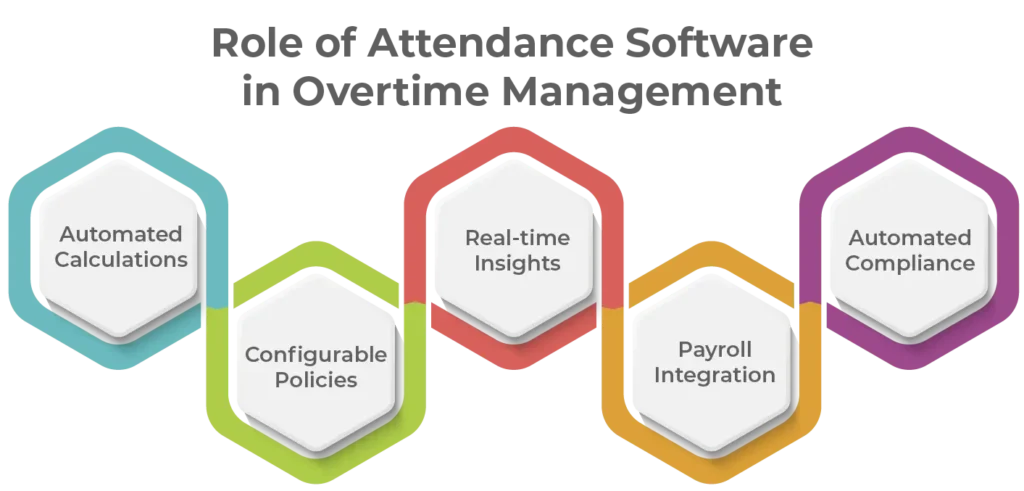
Attendance software requires you to define your shifts while deploying it, resulting in accurate shifts as the system automates calculations for you. Once you assign shifts for your employees, the system can credit and debit working hours based on automated rules. Similarly, it can calculate overtime hours automatically based on shift and attendance timings, enabling streamlined payroll disbursals.
A dedicated attendance software provides customizable attendance and shift policies, enabling the organization to define its shifts, overtime rules, late-coming deductions, etc., according to its company policies. Having such customizability enables HRs to ensure that employees adhere to these policies, as the system shares their attendance details through their Employee Self Service (ESS) portals.
Along with the employees, HRs, and other stakeholders, such as managers and supervisors, can access real-time attendance and shift details using the attendance management system. It helps them gather in-depth insights into employee attendance, enabling them to make data-backed decisions. For example, with real-time dashboards, managers can understand if more employees are requesting overtime and manage their work to ensure that they do not face burnout.
The attendance system also integrates with your payroll software, enabling seamless capture of overtime and other shift details. This data results in accurate calculations, which translates to on-time payouts for the employees. Hence, employees get paid the correct salaries, including their overtime pay, resulting in increased trust and loyalty.
Since the attendance software undertakes all calculations according to the local statutory laws and regulations, overtime calculations remain compliant. As a result, these systems help the organization avoid costly legal fines that might be incurred due to non-compliance.
As we discussed above, an attendance management system plays a major role in ensuring accurate overtime capture. With the help of an attendance system, you get multiple other benefits apart from simply automating the entire process of allocating shifts and capturing employee attendance accurately. These benefits include:
Automated rule-based shift scheduling provides you with added flexibility in allocating employee shifts by eliminating overlap, double-shifts, and other last-minute confusion. It helps avoid all forms of shift allocation errors, providing employees with shifts according to the company’s requirements. Even if your organization consists of 24/7 shifts, a dedicated system can automate it without any errors, resulting in enhanced efficiency.
Additionally, the software avoids human biases, ensuring fair and transparent shift allocations. It shares shifts evenly, preventing favouritism, helping employees avoid burnout. Having such fair practices improves employee trust and loyalty with your organization, resulting in increased engagement too.
With clear shift schedules, employees can adjust their timings beforehand, resulting in improved engagement and productivity. It also results in fewer instances of overtime as employees remain productive. Additionally, having well-defined rosters also results in smoother shift handovers, resulting in fewer leaves, which also results in increased overall throughput.
A dedicated attendance system also provides employees with an intuitive ESS portal, which helps them view their current and upcoming shift details, resulting in smoother shift management. They can also request shift swaps easily, providing them with added flexibility. Having such flexible shift options promotes work-life balance and increases job satisfaction.
As for the managers and supervisors, having an automated system vastly cuts down their time spent on shift allocation, shift swaps, and overall management. Since the system also provides them with advanced shift and attendance data, they can easily track the work output of their staff, enabling them to allocate shifts according to employee preferences, further cutting down shift allocation times.
Conclusion
Managing employee shifts, including overtime, late arrivals, etc., has become incredibly easy, thanks to modern attendance management systems. Such software ensures increased efficiency and enhanced accuracy in employees’ attendance data, making it an indispensable part of the modern HR arsenal. If you are planning on deploying a dedicated attendance system, feel free to check out Pocket HRMS, as it is an integrated HRMS with AI-powered automation.