


Payroll Reports are essential for any organization since it serves in improving the overall organizational efficiency and help maintain compliance. Payroll reports provide the organization and the HR team with vital information regarding their employees and their payroll, which helps them make informed decisions.
Payroll Reports are documents generated to provide financial details of the company for a specific pay cycle. It includes various information related to the finances of the company, such as the pay rate, total number of work hours, the TDS deducted from employee salary, and more.
Hence, let us learn about its functions and usage.
While these words are used interchangeably, they are very distinct in practice. Here is a handy comparison for your reference:
| Aspect | Payroll Report | Pay Statement | Payroll Summary |
|---|---|---|---|
| Who reads it | HR, finance, auditors | Individual employee | Management, HR leadership |
| Scope | Company-wide, department-wide, or team-wide | One employee, one pay cycle | Aggregated across the organization or a chosen period |
| Purpose | Compliance, tax filing, audits, record-keeping | Proof of what an employee earned and what got deducted | High-level view of payroll cost, trends, and budgeting |
| Level of Detail | Granular: hours, overtime, deductions, taxes per employee | Granular but limited to one person: gross pay, deductions, net pay | Rolled up numbers: total payroll cost, department-wise spend, headcount cost |
| Frequency | Monthly, quarterly, or annually depending on need | Every pay cycle | Monthly, quarterly, or on demand for leadership reviews |
| Example Use Case | Filing PF, TDS, or PT returns | Employee disputing a salary deduction | CFO checking payroll as a percentage of revenue |
Generating a payroll report has multiple benefits for both the employer and the employees of an organization. Some of the most common advantages of a payroll report are:
Calculating employee payroll and the associated taxes takes a lot of productive time for the HR department. However, if they can generate payroll reports with the help of dedicated HRMS or payroll software, the process becomes easier and streamlined for the team. It results in accurate taxes calculations and on-time payments, resulting in fine avoidance.
With the help of payroll reports, the HR and accounts team can easily determine the cost of paying employees, which helps in better budgeting for the future. It also helps in accurately predicting the expenses for the next salary cycle or even the next quarter, making it a must-have tool in the HR arsenal.
Payroll reports also provide HR with actionable insights over various aspects of payroll such as salary components, paid time offs taken, expenditure on additional benefits, rewards, and more. Tracking these metrics will help the HR team in making necessary changes for better employee engagement and retention.
Payroll reports serve multiple functions across an organization, extending far beyond simple record-keeping:
Now that we have understood the basics of payroll reports, we shall look at the steps involved in the generation of the reports. While the exact process of report generation and data collation would change depending on the type of payroll report, the size of the company and the number of employees working on the report, it usually follows a specific path in general.
Following are some of the common steps required in developing a payroll report:
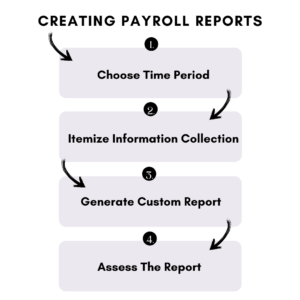
Any kind of payroll report is generated for a specific period. Hence, choosing the dates for the report is the first step in generating it. Additionally, one should also keep in mind the numerous kinds of payroll reports required, such as the ones that are required by the law and the ones used for internal reporting.
In this step, one needs to decide the components of the report. Various information is collated as a part of the report generation process, such as employee name, working hours, salary pay-out and its bifurcation, taxes deducted, etc. The selection of data items would be decided based on the report and its function.
Based on the time and the data components, the report can be generated manually on spreadsheets. However, a more refined approach would be to take the help of an HRMS or payroll software to generate custom reports based on the chosen parameters. If you are looking for an ideal payroll system, we have a complete Payroll Software Comparison Guide for Indian organizations.
Once the report is generated, one needs to analyse the data to gather insights about the information and the company. The management can gather various valuable insights with the help of the report such as the amount required for employee salaries, the appraisal budget, employee leaves, and more. With this information, they can make informed decisions, ensuring the company’s success.
Conclusion
Payroll reports store multiple crucial data such as employee payroll information, pay rate, TDS, overtime charged and their rates, additional benefits provided and their cost to the company, employee leaves and related information, and more. Hence, these reports help in improving the overall efficiency of the payroll management of the organization.
Payroll reports are extremely crucial for the success of an organization as it helps in taking informed decisions, while also providing the HR and management with valuable data. Hence, one should take precautions to ensure the complete accuracy of the data and utilize the latest innovations such as HR software for the same.