
Managing employees strategically has become essential along with dealing with changing workforce expectations, skill shortages, new ways of working, and rapid technological advancements. Businesses now need to focus on more than hiring employees and managing daily HR tasks.
They need to develop talent, improve employee experiences, retain skilled professionals, and align their workforce with long-term business goals. This is where a strategic approach to people management becomes important. Let’s understand how organizations can manage their workforce more effectively through Human Capital Management (HCM).
Human Capital Management (HCM) is the collective approach to attract, recruit, train, and manage the employees of an organisation. It considers the workforce of a company to be its ‘capital’, and their knowledge and expertise to be valuable commodities, supporting business growth.
The main goal of human capital management is to have a productive workforce that remains engaged with their workplace. To ensure its fulfilment, they build and develop a workplace where their employees are valued for their uniqueness, appreciated for their effort, and compensated adequately for their time. Modern businesses utilise a dedicated human capital management system to undertake all tasks related to HCM.
The major components of human capital management work together to ensure that the employees remain engaged with their company for longer. These components are responsible for enabling the HR teams to manage their employees efficiently:
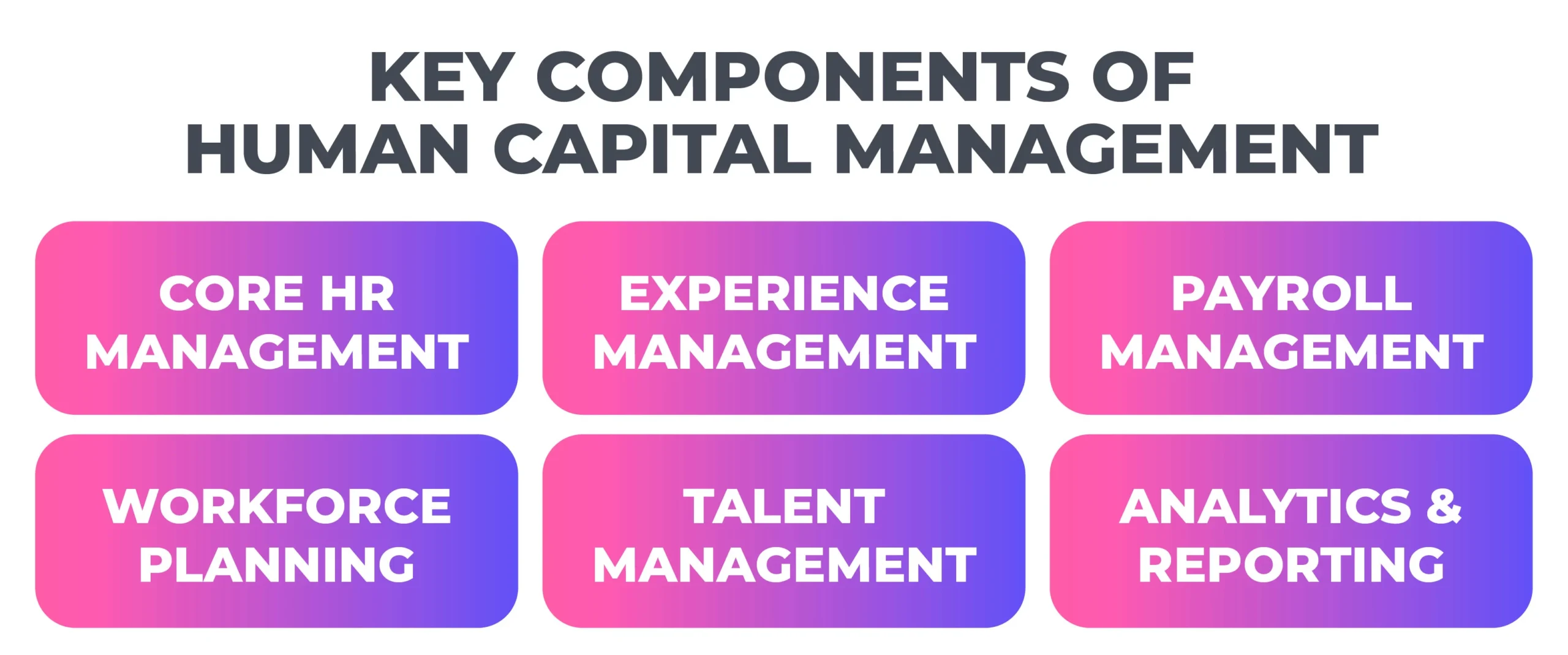
Core HR includes all basic aspects of HR such as employee management, attendance and leave management, payroll management, benefits administration, and more. Since it is a part of HCM, core HR enables the HR team to manage their employees effectively by taking care of their administrative requirements.
Managing employee experience is a part of human capital management as it helps in retaining employees through job satisfaction and engagement. Employee experience is a huge reason why employees remain in an organisation for longer, as it helps them feel good about being a part of their company.
Similarly, managing employee payroll is a part of HCM, as it enables the organisation to compensate the staff members for their time and effort. However, being a complex process, it becomes highly time-consuming when undertaken manually. Hence, payroll management is undertaken as a part of human capital management.
Workforce planning is also undertaken as a part of HCM to ensure that the company has enough employees to accomplish its business goals, within the predefined budget. Successful workforce planning helps companies realize their business goals on time, enabling them to grow at the pace required by the business.
Talent management is undertaken in companies, based on workforce planning. It dictates when to hire new talent, or whether to upskill existing talent within the organisation for better results. Similarly, talent management also ensures that the company has a talent pool that can be utilized whenever it requires new talent.
Additionally, analytics and reporting are a part of human capital management as it helps the HR and management understand whether everything is going according to plan. Using people analytics, companies can make data-backed decisions, while statutory reporting enables them to stay compliant with labour laws.
Since HCM is an integral part of employee management, it consists of various functions that help the organization achieve its business objectives. These functions include:
Human Capital Management (HCM) is essential for managing employees effectively and aligning workforce capabilities with business goals. As employee expectations, work models, and HR technology continue to evolve, HCM has become increasingly important for organizations aiming to attract, develop, and retain talent.
HCM helps organizations manage employee performance, recognize employee contributions while improve satisfaction, and create a more engaged workforce.
It helps organizations attract skilled professionals, identify high-potential employees, provide career development opportunities, and retain valuable talent.
Modern HCM systems provide workforce data and analytics that help HR teams make informed decisions about overall employee performance, entire workforce planning, hiring, and development.
HCM helps organizations identify skill gaps, plan training programs, and develop employee capabilities according to current and future business requirements.
It connects employee performance and workforce planning with organizational objectives, ensuring that people and business strategies move in the same direction.
AI, machine learning, automation, analytics, and other HR technologies help streamline repetitive processes while enabling HR teams to focus on strategic workforce management and adapt to changing employee expectations.
Human Capital Management (HCM) can be challenging because it requires balancing employee expectations, business goals, and operational requirements. Creating a positive employee experience requires HR teams to address diverse needs while maintaining fairness. Hiring the right talent can also be difficult due to skill, cultural fit, and compensation considerations. Protecting sensitive employee data from cyber threats is another concern.
HR teams must also reduce administrative workloads, integrate different HR systems, and ensure smooth data flow. Additionally, keeping up with changing labour laws and statutory requirements can make HCM compliance complex and time-consuming for organizations.
Organizations are increasingly looking at Human Capital Management (HCM) as a strategic tool for preparing their workforce for future business needs. With AI-powered features, cloud-based platforms, mobile-first systems, and integrated HR technologies becoming more common, HCM is moving beyond traditional employee administration. These advancements can help organizations improve productivity, make data-driven workforce decisions, and create a better employee experience. Let’s explore the key developments shaping the future of HCM.
AI will play a larger role in recruitment, employee engagement, workforce planning, performance management, and predictive analytics, helping HR teams make faster, data-driven decisions.
Cloud-based and mobile-friendly HCM platforms will become increasingly important, giving employees and HR teams secure access to workforce information and HR services from anywhere.
HCM platforms will increasingly connect with payroll, attendance, leave, recruitment, finance, and other enterprise systems through APIs and integration platforms. This will create a more connected HR ecosystem and reduce manual data entry.
Future HCM solutions will become more customizable, allowing organizations to adapt workflows, communication, learning, and employee services according to their workforce needs.
Advanced analytics will help HR teams understand workforce trends, identify skill gaps, forecast talent requirements, and make more informed decisions about hiring, development, and retention.
With SaaS and integration-platform-as-a-service (iPaaS) models, organizations will have greater flexibility to scale HCM capabilities as their workforce and business requirements change.
Conclusion
Human Capital Management has essential in managing modern workforce. The strategy manages employees while aligning their capabilities with business goals. From core HR and payroll management to talent development, workforce planning, analytics, and employee engagement, HCM brings different aspects of people management together. Although organizations often face challenges related to talent, data security, integration, and compliance, an effective HCM strategy helps overcoming these concerns. With AI, cloud technology, automation, analytics, and mobile-first solutions shaping its future, HCM will continue to help businesses build productive, engaged, and future-ready workforces.
The full form of HCM is Human Capital Management.
HCM is different from traditional HR as it emphasizes a strategic and value-driven approach to employee management. It views employees as assets to the organisation that has the capabilities to fulfil organizational objectives. In contrast, traditional HR management focuses on the administrative and clerical aspects of employee management.
Yes, modern HCM is suitable for small organisations as they are deployed on the cloud, enabling seamless scalability. If you are a small organisation, you can easily customize your implementation of the HCM system to remove the functionalities that you do not use, while keeping the ones relevant for your company.
HR teams can utilize the tools and strategies provided by HCM to provide their employees with a better employee experience, and a positive work environment. HCM systems enable the HR teams to further streamline their processes, as well as enable transparent communications, and enhance talent development, resulting in engaged employees, who can be retained for longer.
No, migrating to an HCM system from traditional HR processes is not challenging as your software vendor takes care of your data, as well as the process of migration. Once the software requirements are finalized, you will be required to answer numerous queries of the implementation team, as well as resolve their doubts. By providing accurate detailed answers to these queries, you can ensure a smooth transition to an HCM system.
HCM supports workforce planning and analytics by having a centralized database of employee information, which can be used for in-depth analytics as well as making calculated guesses about the workforce. It helps the management take important decisions, backed by the data, ensuring the effectiveness of organizational strategies.
Yes, performance management be can handled through HCM tools as they provide various features such as goal setting, performance reviews, training programs, employee performance tracking, and more. These features help the HR teams to analyse the performance of their workforce as well as upskill them effectively.
Modern HCM systems employ a variety of security measures to keep your company and employee data safe. These security measures include encrypting the data, providing secure access control, as well as storing it according to legal compliances. Such measures are required in the modern business world, where cyber threats can easily wreak havoc on business data.