
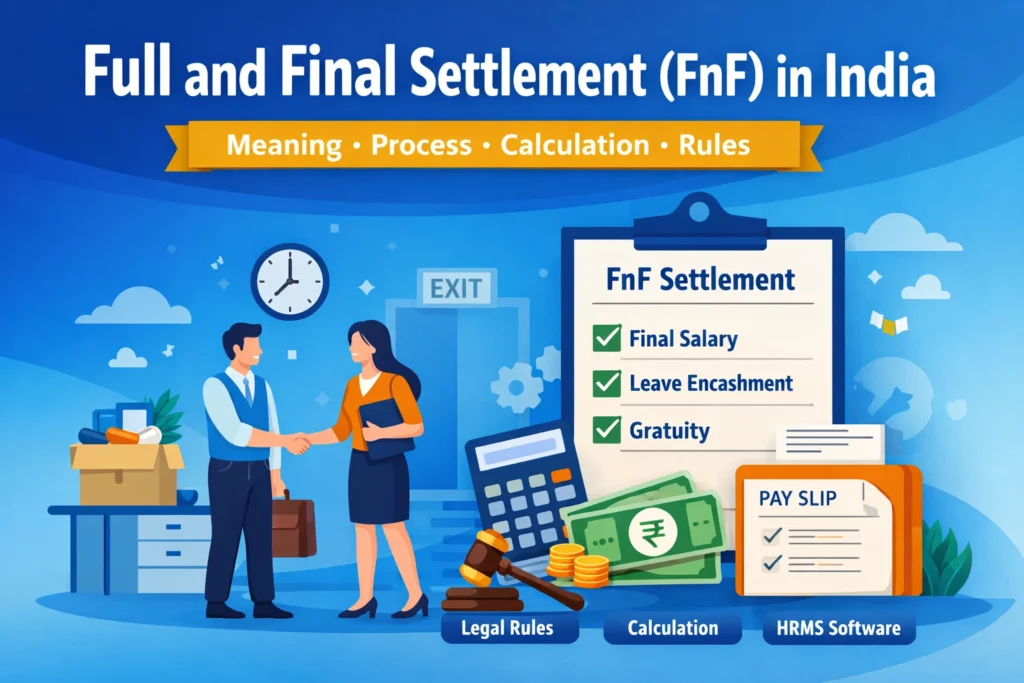
Full and Final Settlement (FnF) is the process of clearing all dues between an employer and an employee when the employee leaves an organization. Whether due to resignation, termination, retirement, or contract completion, FnF settlement ensures that salary, leave encashment, bonuses, gratuity, and other payments are calculated and paid correctly.
In this complete guide, we explain the meaning of FnF settlement, the full and final settlement process, calculation formula, timeline, legal rules in India, and common compliance mistakes.
What is Full and Final Settlement?
Full and Final Settlement refers to the payment of all pending dues owed to an employee after their last working day. It is the final financial transaction between employer and employee.
The settlement typically includes:
- Unpaid salary
- Leave encashment
- Bonus or incentives (if applicable)
- Gratuity (if eligible)
- Reimbursements
- Deductions (loan recovery, notice shortfall, etc.)
FnF ensures that both parties close the employment relationship legally and financially.
What is FnF Settlement?
FnF Settlement is simply the abbreviated form of Full and Final Settlement. Both terms mean the same and are used interchangeably in HR and payroll management.
When is Full and Final Settlement Done?
Full and Final Settlement is processed in the following situations:
- Resignation by employee
- Termination by employer
- Retirement
- End of contract
- Absconding cases
The process begins after the employee’s last working day (LWD).
What is Included in Full and Final Settlement?
| Component | Included in FnF? |
|---|---|
| Unpaid Salary | Yes |
| Leave Encashment | Yes |
| Bonus/Incentives | If applicable |
| Gratuity | If eligible (5+ years service) |
| Reimbursements | If pending |
| PF & ESIC | Processed separately |
| Deductions (Loans, Notice Period) | Yes |
Full and Final Settlement Process in India
Step 1: Resignation Acceptance or Termination Notice
HR confirms the employee’s last working day.
Step 2: Clearance Process
The employee returns company assets such as laptop, ID card, access cards, and documents.
Step 3: Leave Balance Calculation
Unused earned leave is calculated for encashment.
Step 4: Payroll Calculation
Salary is calculated for days worked in the final month.
Step 5: Gratuity & Bonus Check
Eligibility is verified as per statutory rules.
Step 6: Final Payment & FnF Statement
Final payment is released and a detailed Full and Final Settlement statement is shared.
Full and Final Settlement Calculation Formula
Let’s understand FnF calculation with an example.
Example:
- Monthly Salary: ₹40,000
- Working Days in Final Month: 20 days
- Total Working Days in Month: 30 days
- Unused Leave Balance: 10 days
Step 1: Salary Calculation
Per day salary = ₹40,000 ÷ 30 = ₹1,333
Salary for 20 days = ₹1,333 × 20 = ₹26,660
Step 2: Leave Encashment
Leave encashment = ₹1,333 × 10 = ₹13,330
Step 3: Total Payable
Salary (₹26,660) + Leave (₹13,330) = ₹39,990
After deductions (if any), the final payable amount is calculated.
Timeline for FnF Settlement in India
There is no single national deadline under central law, but most companies follow:
- 30 to 45 days from the last working day
Some state Shops and Establishment Acts require payment within 2 working days in termination cases. Delays can lead to legal disputes and penalties.
Legal Rules for Full and Final Settlement in India
Payment of Wages Act, 1936
Ensures timely payment of earned wages.
Payment of Gratuity Act, 1972
Gratuity must be paid within 30 days if the employee has completed 5 years of continuous service.
Industrial Disputes Act, 1947
Governs termination-related compensation in certain cases.
Employers must follow applicable state labor laws as well.
Common Problems in FnF Settlement
- Delay in final payment
- Incorrect leave encashment calculation
- Gratuity miscalculation
- Tax deduction errors
- Disputes over notice period recovery
- Manual payroll errors
How HRMS Software Automates Full and Final Settlement
Modern HRMS and payroll software simplify the FnF settlement process by:
- Automatically calculating final salary
- Auto-adjusting leave encashment
- Integrating gratuity calculation
- Managing notice period recovery
- Generating FnF statements instantly
- Ensuring statutory compliance
With automated payroll workflows, HR teams reduce errors and process settlements faster while ensuring compliance with Indian labor laws.
FnF Settlement Format (What Should It Include?)
- Employee Name & ID
- Date of Joining
- Last Working Day
- Salary Details
- Leave Balance
- Bonus/Gratuity Details
- Deductions
- Net Payable Amount
Providing a clear FnF statement reduces disputes and builds transparency.
FAQs on FnF Settlement
What is FnF in salary?
FnF refers to the final salary and dues paid to an employee after leaving the organization.
How long does full and final settlement take?
Usually 30–45 days after the last working day, depending on company policy and state laws.
Is gratuity part of FnF settlement?
Yes, if the employee has completed 5 years of continuous service.
Can an employer delay FnF settlement?
Unreasonable delays may violate labor laws and lead to legal consequences.
Is Full and Final Settlement mandatory?
Yes, employers must clear all dues when an employee exits.
Conclusion
Full and Final Settlement (FnF) is a critical part of the employee exit process. It ensures that all pending salary, leave encashment, gratuity, and other dues are settled accurately and legally.
Manual processing increases errors and compliance risks. Automating the process with payroll-integrated HRMS software ensures faster, accurate, and compliant FnF settlements.
