Gig Economy in India: 2026 Rules, Rights & Compliance Guide

Gig Economy in India
Reading Time: 5 minutes

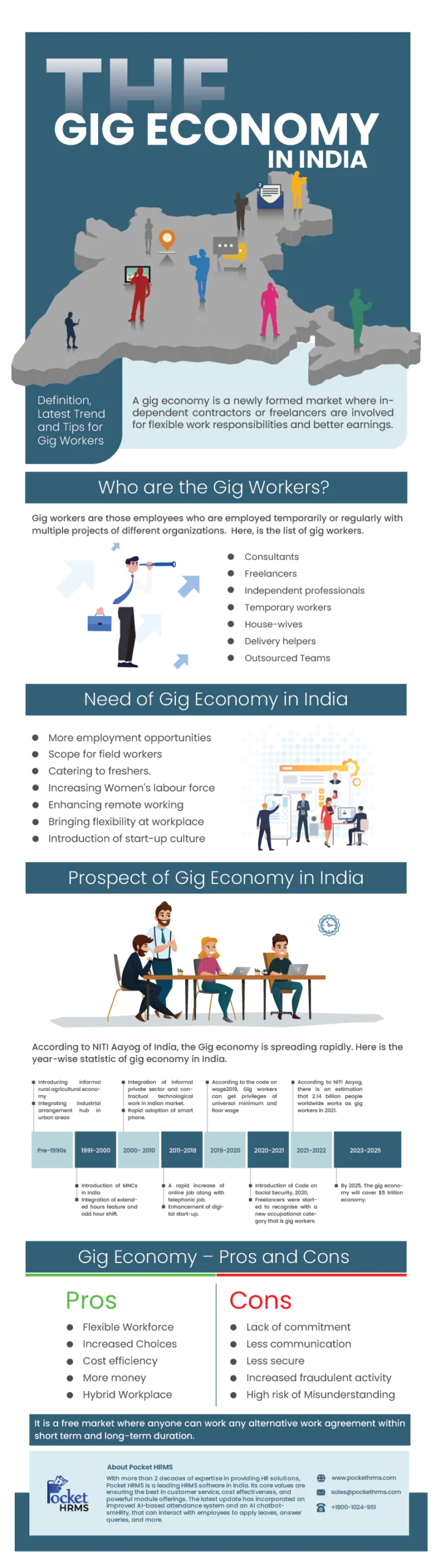
A gig worker earns through task-based or project-based work outside a standard employer-employee relationship. A platform worker specifically finds this work through a digital app or platform, while an aggregator is the digital intermediary connecting the two. The Code on Social Security, 2020 formally distinguishes these three roles, and the distinction matters for compliance, since obligations attach differently to different roles.


How big is India’s Gig Workforce?

India recorded 7.7 million gig workers in 2020-21, according to NITI Aayog, with that number projected to reach 23.5 million by 2029-30 at a compound annual CAGR of nearly 17%.


Growth is concentrated in last-mile logistics, quick commerce, and home services, sectors where blue-collar gig hiring has outpaced the white-collar freelance segment.


The New 2026 Social Security Code Rules for Gig Workers

The new rules under the Code on Social Security, released in January 2026, set out how gig and platform workers qualify for centrally funded welfare benefits. The table below summarizes the core provisions and what each one requires from an aggregator:


Aspect Payroll Report Pay Statement Payroll Summary
Who reads it HR, finance, auditors Individual employee Management, HR leadership
Scope Company-wide, department-wide, or team-wide One employee, one pay cycle Aggregated across the organization or a chosen period
Purpose Compliance, tax filing, audits, record-keeping Proof of what an employee earned and what got deducted High-level view of payroll cost, trends, and budgeting
Level of Detail Granular: hours, overtime, deductions, taxes per employee Granular but limited to one person: gross pay, deductions, net pay Rolled up numbers: total payroll cost, department-wise spend, headcount cost
Frequency Monthly, quarterly, or annually depending on need Every pay cycle Monthly, quarterly, or on demand for leadership reviews
Example Use Case Filing PF, TDS, or PT returns Employee disputing a salary deduction CFO checking payroll as a percentage of revenue


Steps for HR Teams for Complying with New Labour Codes

Here is what HR teams should undertake to ensure compliance with the New Labour Codes:

  1. Build an engagement-day tracker per worker, per aggregator relationship, resetting each financial year.
  2. Set up real-time registration workflows for new gig workers on the e-Shram portal.
  3. Keep gig worker records separate from employee records in the HRMS to avoid conflating benefits eligibility rules.
  4. Flag workers approaching the 90 or 120-day threshold before the financial year closes, since eligibility is judged on the prior year’s engagement.
  5. Assign clear ownership, typically HR and finance jointly, for calculating and remitting the turnover-based contribution.
  6. Document the distinction between gig workers and consultants or contractors in internal policy, since compliance obligations differ between them.


Processing of Taxes for Gig Worker Payments

Gig worker payments are typically processed as professional or contract fees rather than salary, which changes both the applicable TDS provision and the payroll workflow. Here is a breakdown:


Aspect Employee Payroll Gig Worker Payment
Applicable TDS Section 192 (Salary) Section 194 (Professional/Contract Fees)
PF/ESI contribution Mandatory above wage thresholds Not applicable unless covered under Social Security Code welfare schemes
GST Not Applicable May apply once the worker’s turnover crosses the GST registration threshold
Payment frequency Fixed Monthly Cycle Task-based or per-cycle, often variable


Misclassification Risk for Employers

The New Labour Codes preserve gig workers’ non-employee status on paper, but if a company exercises employee-like control over a worker, such as fixed hours, exclusivity, or disciplinary action, the classification can be challenged regardless of what the contract says. The exposure includes retroactive PF/ESI liability, penalties, and disputed employment claims.


Applicability of the DPDP Act 2023 to Gig Workers

Aggregators collect location, performance, and identity data on gig workers to run the platform. Under the Digital Personal Data Protection Act, 2023, this qualifies as personal data, and aggregators need consent mechanisms and defined retention limits for it.


Managing a Hybrid Workforce

Companies running blended workforces need HR solutions that keep employee and gig-worker records distinct while still giving HR one place to view total headcount. Access permissions, appraisal cycles, and expense reimbursement rules typically apply only to employees, and a system that fails to separate these categories creates both a compliance risk and an administrative burden.


Here is what you should know when managing a hybrid workforce:

  • Keep gig worker records out of the appraisal and promotion cycle.
  • Apply different access control tiers for gig workers versus full-time employees.
  • Track engagement days and payment history separately from payroll cycles.
  • Maintain audit trails that distinguish gig worker payments from salary disbursements.


Skill-Based Hiring for Gig Workers

Companies are increasingly hiring gig workers for specific skills or short-term projects rather than filling permanent headcount, especially in areas like design, content, data analysis, and specialized tech work where the need is real but not constant. This shift to gig workers lets HR teams source capability on demand instead of committing to a full-time role for work that has a defined start and end point. Here is what major companies are doing:

  • Project-based Sourcing: Hiring for a defined deliverable or sprint rather than an open-ended role.
  • Skills-first Job Descriptions: Listing required competencies instead of years of experience or degree requirements, which widens the gig talent pool.
  • Blended Teams: Pairing gig specialists with full-time staff on time-bound initiatives, such as a product launch or a compliance overhaul.


Faster Time-to-capability: Onboarding a gig worker with a specific skill set typically takes less time than a full-time hire, since the engagement is scoped narrowly.


For HR teams, the operational shift is less about sourcing channels and more about how these workers get evaluated and paid. A gig hire brought on for a defined skill still needs a way to be assessed against the project outcome, even without a formal appraisal cycle, and payroll needs a workflow that treats this differently from a standard salaried onboarding.


Financial Wellness Support for Gig Workers

Gig income is inherently irregular, tied to task volume, seasonal demand, and platform algorithms rather than a fixed monthly cycle. That volatility is one of the most cited pain points among gig workers themselves, and it is an area where an organization can offer support without taking on employer-style obligations.


Here are a few ways companies can financially support gig workers:

  • Earned Wage Access: Letting workers draw down earned but unpaid amounts before the standard payout cycle, reducing reliance on high-interest informal credit.
  • Flexible Payout Frequency: Offering daily or weekly payout options alongside the standard cycle, rather than forcing a single fixed schedule.
  • Financial Literacy Resources: Basic guidance on tax obligations, GST thresholds, and savings, since gig workers manage their own compliance without payroll deducting anything on their behalf.
  • Optional Insurance Enrolment: Making accident, health, or life insurance available for voluntary opt-in, even where not legally mandated, priced through group rates the aggregator can negotiate.
  • Retirement Savings Nudges: Since gig workers fall outside employer PF by default, some platforms have started prompting voluntary contributions to schemes like the National Pension System.


FAQs on Gig Economy


1. Are gig workers eligible for PF in India?

Gig workers fall outside standard PF coverage since they are not classified as employees. Under the Social Security Code, they may access welfare schemes funded by aggregator contributions, but the mechanism differs from employee PF and depends on meeting engagement thresholds.


2. What is the 90-day rule under the Social Security Code?

Draft 2026 rules require a gig worker to be engaged with a single aggregator for at least 90 days in the preceding financial year to qualify for central welfare scheme benefits. The threshold rises to 120 days when a worker is engaged across multiple aggregators.


3. Do gig workers pay GST in India?

They are required to pay GST only if their turnover crosses the applicable GST registration threshold. Below that, no GST registration is required.


4. Is a gig worker legally an employee in India?

No, the Code on Social Security, 2020 explicitly defines gig and platform workers as distinct from employees, preserving the non-employment relationship even as it extends select welfare benefits to this category.

Contact Us

Contact Us